Social Media Lead Generation in the UK: How to Generate Leads With AI in 2026 and 2027
Social media lead generation for UK businesses: native lead tools on Facebook, Instagram, TikTok and X, AI qualification and the UK rules for 2026-27.
In this article
Quick answer: Social media lead generation turns followers into enquiries through lead forms, DMs and links. In the UK, use each platform's native form (Meta, TikTok, X), let AI draft creative and ask the first qualifying questions, and keep a human for sales. Social DMs count as electronic mail, so marketing follow-ups need consent or a soft opt-in.
Your posts pull in likes, comments and the odd DM, yet hardly any of it becomes a paying enquiry. That gap is the whole job.
Most advice says the fix is to move people into your DMs. UK law treats a social media DM as electronic mail, though, and since February 2026 fines for breaking the marketing rules can reach £17.5m. Here's what works in the UK, where AI helps, and the rules for 2026 and 2027.
What is social media lead generation in 2026?
It's the work of turning attention on social media into prospects you can contact. A lead is someone who gives you a way to reach them, or who starts a conversation about buying. Likes and follows don't count.
What a lead looks like depends on the business. For a dentist it's a booking request, for a wedding photographer it's a date check, and for a B2B agency it's a discovery-call form with a company name attached.
Leads now arrive by three routes. A native form opens inside the app, and Facebook, Instagram, TikTok or X fills in some of the person's details for them. Chats in Messenger, Instagram Direct or WhatsApp start from a post, an ad or a comment, and your own website catches the rest through a bio link or an ad.
Chat has grown fastest. Meta said in June 2026 that people now hold more than a billion active conversation threads with businesses every day across WhatsApp, Messenger and Instagram. For a local business, the first question about price or availability can arrive as a message, before anyone visits a website.
AI changed the work in three places. It writes ad variations and images in minutes, it asks new leads the first qualifying questions at 2am, and it runs the bidding and audience choices inside automated campaigns on Meta and TikTok.
The rulebook stayed put. Every message an AI sends on your behalf falls under the same UK rules on who you can contact and how, which is why this guide covers both.
How to generate leads on social media: the 2026 platform tools
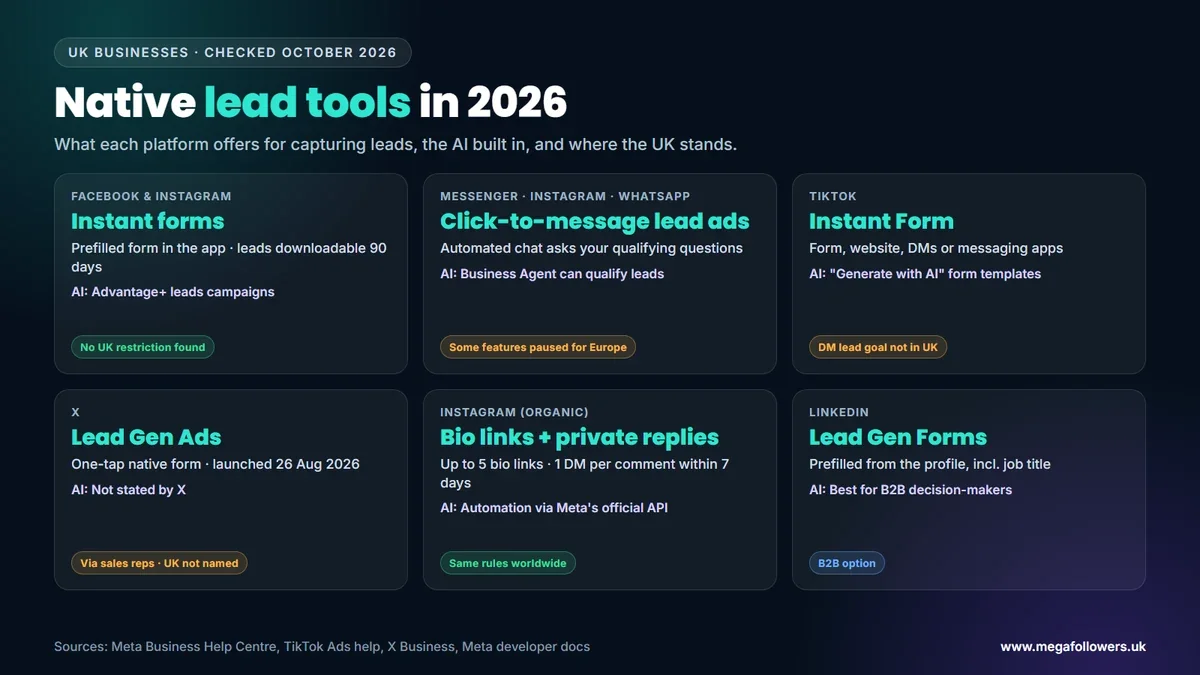
Start with the native lead tool on the platform your buyers use most. Native forms keep people inside the app, so nobody waits for a landing page to load on a weak phone signal. Here's what each platform offers this year, and where the UK stands.
| Platform | Lead tool | How it captures | AI built in | UK status |
|---|---|---|---|---|
| Facebook and Instagram | Instant forms (Leads objective) | Prefilled form inside the app | Automated Advantage+ leads campaigns | No UK restriction found |
| Facebook, Instagram, WhatsApp | Click-to-message lead ads | Automated chat asks your questions | Meta Business Agent can qualify leads | Ads run; Meta flags some messaging features as paused for "Europe" |
| TikTok | Lead Generation objective, Instant Form | Form, website, DMs or messaging apps | "Generate with AI" form templates, Symphony creative | Instant Forms on TikTok's UK site; DM lead goal not in the UK |
| X | Lead Gen Ads | One-tap native form, prefilled next time | Not stated by X | Launched 26 Aug 2026 through X sales reps; UK not named |
| Instagram (organic) | Bio links, action buttons, private replies | Link, lead form or one DM per comment | Automation through Meta's official API | Same rules worldwide |
| Lead Gen Forms | Form prefilled from the profile | Not covered here | B2B option |
 Facebook and Instagram lead ads
Meta's instant forms sit under the Leads objective in Ads Manager. Someone taps the ad, a form opens with their name, email and phone already filled in, and they submit without leaving the app.
You pick one of three form types. More volume is the default and the quickest to submit. Higher intent adds a review screen so people check their details first, which suits businesses that ring every lead back, while Rich creative lets you add images and brand colours.
Build the form in Ads Manager to get the useful extras: custom questions, conditional logic, gated downloads, phone checks by one-time code and work-email checks. Add your privacy policy link. Then decide where the leads go, because Meta only keeps form leads downloadable for 90 days.
Click-to-message lead ads do the same job inside a chat. Their Automated chat template asks your qualifying questions in Messenger, Instagram Direct or WhatsApp, then saves the answers as a lead you can export to a spreadsheet or CRM.
Two settings matter this year. Meta's Advantage+ leads results claim 14% lower cost per lead and 10% lower cost per qualified lead, from 20 tests between November 2024 and January 2025, with the 10% figure at 83% confidence. Since April 2026, new campaigns can only optimise for qualified leads if your CRM sends results back through Meta's Conversions API.
TikTok lead generation
TikTok's Lead Generation objective sends people to an instant form, your website, TikTok DMs or a messaging app. A Leads Centre syncs all of them to a CRM. Instant Forms need a privacy policy URL, and the templates include a lead qualification form plus a "Generate with AI" option that drafts the form for you.
On its UK business site, TikTok offers Instant Forms and website lead generation. Two newer tools aren't available here yet. One is the lead goal that picks contact details out of DMs automatically; the other is Message Assistant, a lead-collecting chatbot still in limited testing elsewhere.
X Lead Gen Ads
X launched Lead Gen Ads on 26 August 2026. People tap once to open a form on X, and their details prefill on later forms. The ads run as image, video or carousel units under a new Leads objective, with a Leads Centre for exports. Access currently goes through an X sales rep, and the launch post doesn't name the UK.
Organic routes: bio links, comments and DMs
You can collect leads without an ad budget. Instagram lets you add up to five links to your bio, and its action buttons can attach a lead form to your profile, though Meta is still rolling those out.
Comment-to-DM works through Meta's official private replies feature, within tight limits. Each commenter gets one message, sent within seven days of their comment, and the conversation only carries on if they reply, inside a 24-hour window.
People check your profile before they hand over an email address. A thin profile with a handful of followers gives them a reason to hesitate, which is where Instagram followers help a newer account look established while your content does the persuading.
For B2B services, LinkedIn's Lead Gen Forms prefill from someone's profile, including job title and company. Test them if you sell to directors and managers.
AI social media lead generation: where AI helps and where a person must step in
AI earns its place at four stages of social media lead generation: creative, qualifying, scoring and follow-up. A person still needs to own the sale and the compliance.
AI for ad creative
Meta's Advantage+ creative can generate ad text, images and backgrounds, and ads made with it may carry an "AI info" label. TikTok's Symphony Creative Studio is free for TikTok for Business users and labels its output "AI-generated" where TikTok's ad policy requires. Use them to test more versions of one offer. Keep the winners.
A sensible first test is three headlines and two images against one form. Give it a week before you judge cost per qualified lead, because the first few days rarely settle.
AI for qualifying leads
On click-to-message ads, the Automated chat template asks your questions before a lead ever reaches a person on your team. Business Agent, Meta's AI agent for companies, goes further. Meta says it answers customer questions, qualifies incoming leads and books appointments in WhatsApp and Messenger, with Instagram to follow (June 2026).
Getting started with Business Agent is free, and Meta One business plans from $14.99 a month add more usage (September 2026). Three cautions apply before you build around it:
- Meta hasn't named the UK for Business Agent.
- On WhatsApp, Business Agent replies cost $2.00 per million tokens from 1 August 2026, which Meta puts at roughly 4 to 5 US cents a message.
- Meta's help pages flag some messaging ad features as unavailable for "Europe" without saying whether that includes the UK.
Whichever tool you use, write the qualifying chat the way a good receptionist talks. Ask what they need, when and where. Then offer a person, and leave pricing to them, because a quote needs judgement a script doesn't have.
Our guide to which Meta AI tools work in the UK tracks these changes. Check it before you commit budget.
AI for lead scoring
Since 5 February 2026, the Data (Use and Access) Act has let organisations make solely automated significant decisions on most lawful bases, with safeguards attached. Those safeguards mean telling people, letting them challenge the decision and offering human review. So far, the regulator hasn't said whether scoring sales leads counts as one, so treat it as a judgement call.
Scoring itself is useful. An AI that ranks leads by budget, timescale and postcode lets a one-person business ring the warmest five first. Keep a person able to accept, reject or change each score, and the decision stays out of "solely automated" territory.
AI for follow-up
Speed wins leads. Meta gives businesses up to 24 hours to reply after someone messages them, and on WhatsApp that window resets each time the customer writes again.
An AI reply inside that window beats a human reply the next morning. CAP's June 2026 guidance adds a warning: advertisers stay responsible for anything their AI produces and for automated campaigns. Read the scripts before they go live, and check them again after any platform update.
The UK rules for contacting social media leads
UK rules split social media lead generation in two: collecting the lead, and marketing to it afterwards. Collecting falls under UK GDPR. Marketing messages fall under PECR, the Privacy and Electronic Communications Regulations, and that's the part most social media advice skips.
The ICO says direct messages on social media count as electronic mail, putting them alongside email, texts, voicemail and in-app messages under the same marketing rules. Feed ads don't count, because the platform shows them openly instead of storing them for one recipient. That leaves a boosted post outside PECR's consent rules, while a marketing DM to a consumer needs consent or a soft opt-in.
Which rule applies depends on who the lead is. PECR treats people and companies differently:
- Individuals, including sole traders and ordinary partnerships, must have consented, or fall under the soft opt-in.
- Limited companies, LLPs and Scottish partnerships can receive marketing without consent, as long as you say who you are and give a working opt-out.
- A named person's work email is still personal data under UK GDPR, so the collection rules apply to B2B leads too.
Your own customers and serious enquirers fall under the soft opt-in. All five conditions must hold: you collected their details yourself, during a sale or negotiations for one, you market only similar products, you offered an opt-out at the time, and you offer one in every message. According to the ICO, an online enquiry asking for more details may be enough to count as negotiations, though it rules out the soft opt-in for any bought-in list.
Consent only counts if people give it freely, and it must be specific, informed and unambiguous. Pre-ticked boxes fail that test. When you collect details, tell people who you are, why you want them, your lawful basis, how long you'll keep the data and what their rights are.
| Who the lead is | How you got their details | Can you send marketing DMs, emails or texts? |
|---|---|---|
| Individual or sole trader | Opted in on your form | Yes, within what they agreed to |
| Individual or sole trader | Asked about your products, and you offered an opt-out | Yes, for similar products (soft opt-in) |
| Individual or sole trader | Followed you or liked a post, nothing more | No, not without consent |
| Anyone | Bought or rented list | Only with consent naming your business; never the soft opt-in |
| Limited company or LLP | Corporate email or DM | Yes, if you identify yourself and offer an opt-out |
| Charity supporter | Showed support, and got an opt-out | Yes, under the charity soft opt-in (since 5 Feb 2026) |
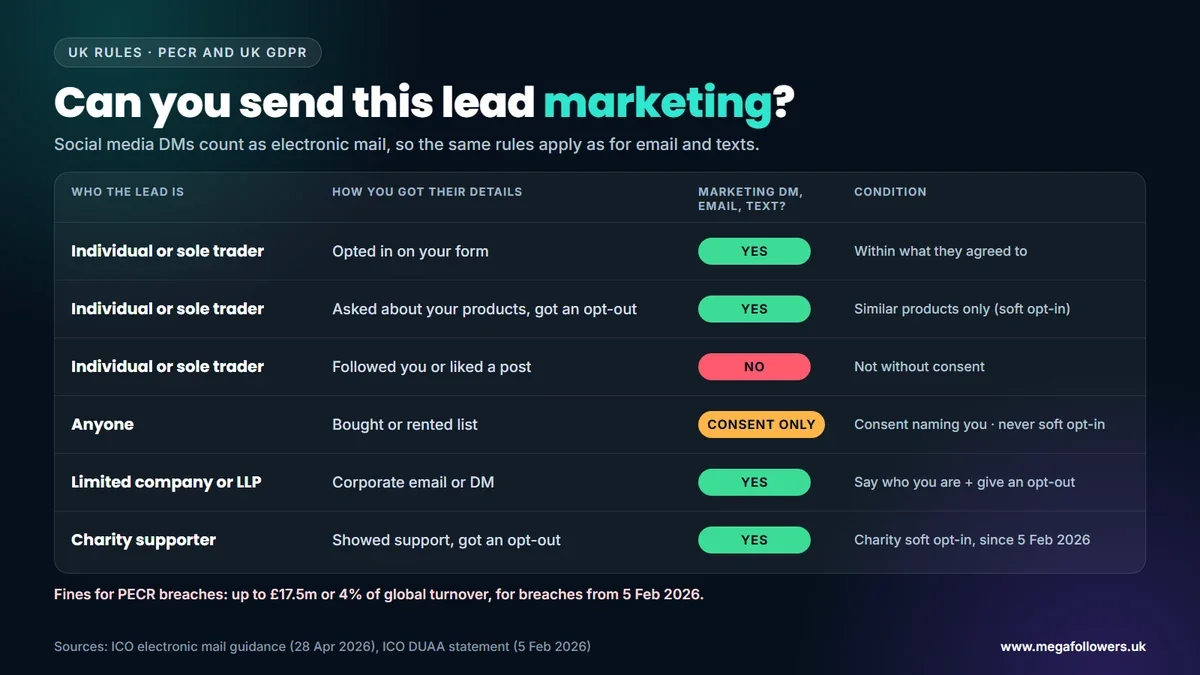 Penalties went up this year. The Data (Use and Access) Act brought higher PECR fines of up to £17.5m or 4% of global turnover, for breaches from 5 February 2026. On 30 September 2026 the ICO became the Information Commission, so newer guidance carries the new name.
Retargeting has its own catch. According to the regulator's final cookie guidance, published on 29 April 2026, no advertising purpose counts as strictly necessary. Tracking pixels for retargeting still need consent, which your cookie banner has to collect before the pixel fires.
In practice, three habits keep most small businesses on the right side. Add a clear marketing opt-in to every lead form, keep a suppression list of people who opted out, and record where and when each lead came in. People have an absolute right to object to direct marketing, so honour opt-outs on every channel.
What most guides get wrong: "Move it to the DMs" advice skips PECR entirely, as if a DM were a private chat with no rules attached. A marketing DM to a consumer needs consent or a soft opt-in, exactly like an email. And the 2025 Act didn't make direct marketing a recognised legitimate interest. It's listed only as an example of one, so the usual balancing test still applies.
A 6-step AI lead funnel for UK small businesses
This sequence takes one offer from post to qualified lead, with a rule check at each step. It suits a small UK business where one person runs social.
- Pick one offer and one lead magnet. A price guide, a checklist or a quote all work. If you call it free, CAP rules 3.23 to 3.26 apply: say what someone has to do to get it, and don't charge more than the unavoidable cost of responding. Prompt: "Suggest five lead magnet ideas for a [business] in [town] that a customer would swap an email address for."
- Say what you're collecting, upfront. The ASA's lead generation advice says ads must make their commercial purpose clear, and footnotes or disclaimers are unlikely to be enough. If a creator promotes your offer, their post needs "Ad" at the start.
- Build the form. Use the Higher intent type if you plan to ring leads, add your privacy policy link, and add a custom question asking for marketing consent with no answer chosen in advance.
- Add AI qualification. Use the Automated chat template, or Business Agent where your account has it. Keep it to three questions, such as service, timescale and postcode, then hand over to a person. Prompt: "Write three short, friendly qualifying questions for someone asking about [service], in UK English."
- Send leads to a CRM from day one. Meta keeps instant-form leads downloadable for 90 days, so connect a CRM or an automation tool and tag each lead with its source.
- Follow up fast, and only as allowed. Reply inside the 24-hour messaging window. Send marketing only to people who opted in or qualify for the soft opt-in.
Here's how that looks in practice. For example, a Leeds bathroom fitter might offer a free price guide through a Higher intent form shown to homeowners within 20 miles, ask three questions by automated chat and ring the warmest leads the same day. Anyone who said yes to the marketing question then gets monthly offers by email, while everyone else gets the guide and an answer to their enquiry.
Steps 2 and 6 are the easiest to skip under time pressure. For the content side of the funnel, our AI workflow for creators covers scripting, editing and captions.
How do you measure social media lead generation?
Measure the leads that turn into money, and ignore follower counts for this job. Four numbers cover it:
- Cost per lead: ad spend divided by leads.
- Cost per qualified lead: spend divided by leads that pass your qualifying questions.
- Lead-to-customer rate: the share of leads who buy.
- Time to first reply: how long a new lead waits before a person or agent answers.
Here's a worked example with round numbers. Say £300 of ad spend brings 60 leads, which is £5 per lead; if 15 pass your questions, each qualified lead cost £20, and if three become customers, each customer cost £100. That last figure is the one to compare with what a customer is worth.
Tag every lead with its platform and campaign, using a CRM field or a UTM link. You'll see which posts bring buyers and which only bring form fills, and that difference decides where next month's budget goes.
Connect the CRM to Meta early. Its qualified-leads optimisation now needs the Conversions API, and once connected, Meta can optimise for the leads that become customers rather than the ones that only fill in a form.
Review the numbers monthly, and give any change at least two weeks before you judge it. For the wider case for social media in a UK marketing plan, see why social media still matters for UK businesses.
What changes for social media lead generation in 2027?
Most of the change for 2027 is already law. The Data (Use and Access) Act rules that started on 5 February 2026 (higher PECR fines, the charity soft opt-in and new cookie exceptions) are the baseline you'll work under all next year.
Guidance is what's still coming. The regulator's guidance plan and its related plan pages list these dates:
- Autumn 2026: updated PECR advice for small organisations, covering the new rules.
- Winter 2026: final guidance on automated decision-making and profiling, which matters for AI lead scoring.
- Spring 2027: an update to the guidance on what to tell people when you collect their data.
- No date yet: guidance on the higher PECR fines, plus a statutory code of practice on AI and automated decisions.
Two of those dates matter most for lead generation. Expect the automated decision-making guidance to clarify how AI scoring and qualification fit the new rules, and the Spring 2027 update covers the privacy information that belongs on your lead forms.
One possible change has no date at all. Ministers are considering whether some low-risk advertising cookies could run without consent; the ICO gave its advice in May 2026, and nothing has changed yet.
Platforms have said less. TikTok announced Agentic Leads on 5 October 2026, an AI agent that captures and qualifies leads in DMs and website forms, with no launch date or market list. Meta, X and LinkedIn haven't announced anything dated for 2027 (checked October 2026).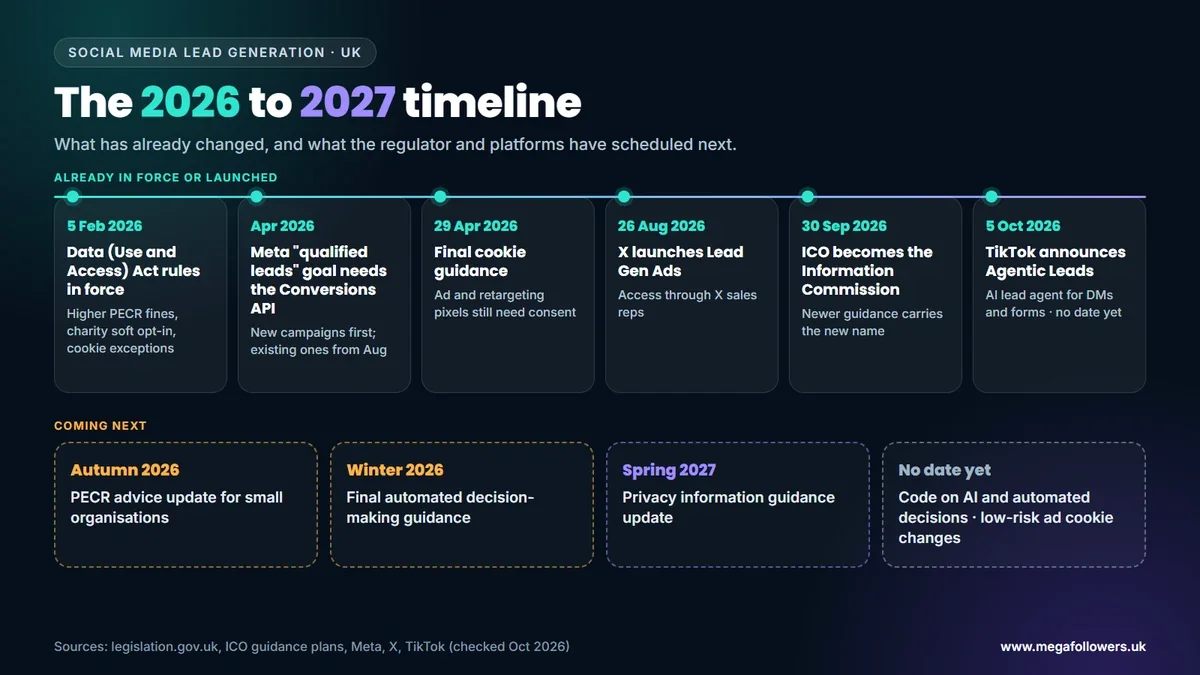
Before 2027, run a short check on your own setup. Four questions cover most of it:
- Every lead form has a privacy policy link and an unticked marketing opt-in.
- Your AI chat scripts say what they collect, and a person can step in.
- Opted-out contacts sit on a suppression list that every tool reads.
- Your cookie banner collects consent before any retargeting pixel fires.
Our view: AI agents will handle more first conversations in DMs through 2027. Because UK law treats those DMs as electronic mail, the consent rules above will matter more next year. Set up opt-ins and suppression lists now, and the 2027 changes should only mean updating some wording.
Leads follow trust. Social proof builds it.
Before anyone fills in a form, they look at who's asking. A business profile with a few dozen followers and silent posts gives them a reason to scroll past, while one with an active audience gets the benefit of the doubt.
Mega Followers UK helps a newer profile look established while your lead tools do the converting. Facebook page likes build the number visitors see first. TikTok followers and X (Twitter) followers back up the profiles you advertise from.
On Instagram, Instagram likes make each new post look active from the start. Every order uses real-looking accounts and needs no password.
Our 30-day refill guarantee covers both your followers and your likes, so the numbers hold. Pair it with a clear offer, an honest form and the UK rules above, and fewer of the people who check your profile will leave without getting in touch.
Frequently asked questions
Which platform should UK businesses use for lead generation?
Pick by audience. Facebook and Instagram lead ads suit consumers and local services, LinkedIn Lead Gen Forms suit B2B decision-makers, and TikTok suits consumer offers aimed at younger buyers. Meta's instant forms are the most established and the easiest to test, so run one platform well for 60 days before adding another.
What does social media lead generation cost a UK business?
No official UK benchmark exists; cost per lead varies by sector, offer and form type. In its own tests, Meta reports that Advantage+ leads campaigns cut cost per lead by 14%. Set a test budget, track cost per qualified lead, and compare that figure with what a new customer is worth to you.
Can AI reply to Instagram comments and DMs automatically?
Yes, through Meta's official messaging tools. A private reply can send one message to someone who commented, within seven days of the comment, and the chat continues only if they answer. Marketing follow-ups after that still need consent or a soft opt-in, because UK law treats DMs as electronic mail.
Do I need consent to email leads from Facebook lead ads?
For individuals and sole traders, yes, unless the soft opt-in applies. That means they asked about your products, you offered an opt-out when you collected their details, and you only market similar products. Add a marketing consent question to the form. You can email limited companies without consent, as long as you offer an opt-out.
Can I buy a list of leads and message them on social media?
No. The ICO says you must never use the soft opt-in on a bought-in list. You'd need consent that names your business and covers the channel you use. Fines for breaking the electronic marketing rules can reach £17.5m or 4% of global turnover for breaches since February 2026.
Is AI lead scoring allowed under UK data law?
Yes, with care. Since February 2026 the Data (Use and Access) Act allows solely automated significant decisions on most lawful bases, with safeguards such as human review. The regulator hasn't said whether lead scoring counts as significant, so keep a person able to check and change each score.
Are TikTok lead ads available in the UK?
TikTok's UK business site offers Instant Forms and website lead generation. Two newer tools aren't available here yet: the lead goal that collects contact details from DMs automatically, and the Message Assistant chatbot. Check Ads Manager on your own account before you plan a campaign around either feature.