How AI Helps Influencers on Social Media Grow Faster
How AI helps influencers on social media: free tools from TikTok and Meta for ideas, scripts, clips and translation, plus the UK rules on AI labels.
In this article
Quick answer: Here's how AI helps influencers on social media, in five practical ways: finding ideas people search for, drafting scripts and captions, cutting long videos into clips, translating Reels into other languages and handling routine replies. It speeds up the making. Reach still depends on people, so creators pair AI with social proof and the UK's labelling rules.
You post four times a week, reply to every comment and edit until midnight, and your follower count barely moves. Meanwhile every "AI for influencers" guide you find turns out to target brands running campaigns, full of tools you'll never pay for.
This guide covers the creator's side instead. It walks through the free AI tools Instagram, Facebook and TikTok have built in, what changed in 2026 and where UK rules draw the line.
How AI helps influencers on social media: the short version
AI takes the slow jobs off your plate. The platforms themselves now ship most of the useful tools, and they cost nothing, so the table below sticks to those rather than paid apps.
| Job | Platform tool | What it does | Status (September 2026) |
|---|---|---|---|
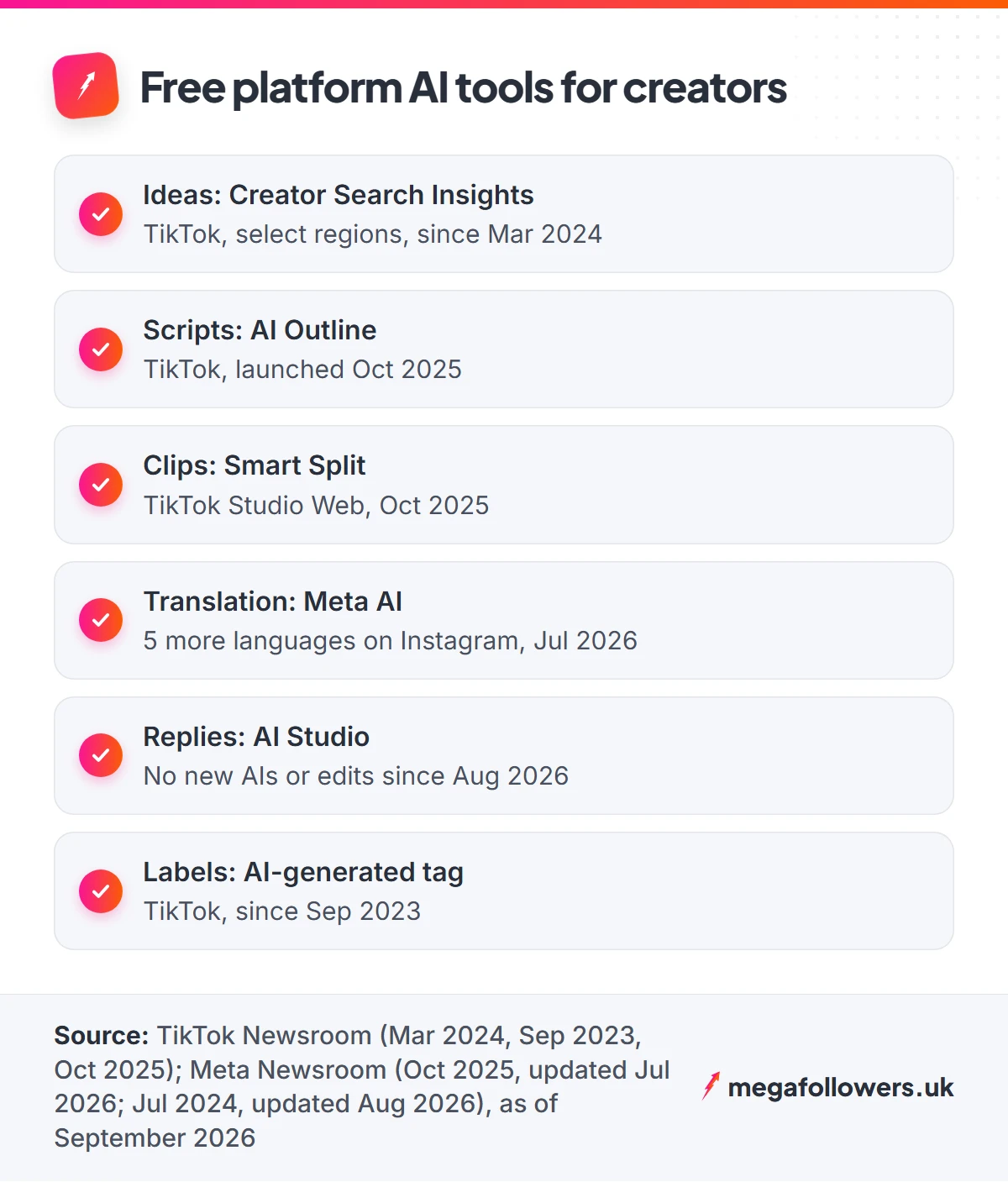
| Finding ideas | TikTok Creator Search Insights | Shows topics people search for often | Live in select regions since March 2024 |
| Scripting | TikTok AI Outline | Drafts titles, hashtags, hooks and outlines | Launched October 2025 for creators 18+ in the US, Canada and select markets |
| Editing | TikTok Smart Split | Clips, reframes, captions and transcribes long videos | TikTok Studio Web, globally, since October 2025 |
| Translation | Meta AI translations | Dubs and lip-syncs Reels into other languages | Free; French, German, Italian, Japanese and Korean added on Instagram in July 2026 |
| Replies | Meta AI Studio creator AIs | Answers common DMs and story replies | Frozen: no new AIs or edits since August 2026 |
| Labelling | TikTok AI-generated label | Marks realistic AI content for viewers | Available since September 2023 |
There's a catch, though. AI can make ten videos in the time you used to make two, but a new account still shows zero followers to the first person who taps on the profile. That's the cold-start problem, and it's why many creators start with a base of real Instagram followers or TikTok followers so their AI-assisted content lands on a profile that already looks trusted.
Finding ideas people already search for
Search data beats guesswork. TikTok's Creator Search Insights, which launched in March 2024, lists topics that people search for often, sorted by category or matched to the kind of content you already make. You find it by typing "Creator Search Insights" into TikTok's search bar.
That matters because searches show intent. Someone typing "cheap weekend in Edinburgh" wants a video about exactly that, and a creator who makes it has a ready audience before posting.
General chatbots help here too, as long as you feed them real inputs. Paste in your last ten captions and your best-performing topics, then ask for twenty angles on the winners. Bin the generic ones. Keep the three that only you could film.
Here's an example of how that plays out. A Manchester fitness creator whose best videos cover cheap home workouts might get back "gym alternatives for rainy weeks", "kit under £20" and "workouts for small flats". All three fit the channel, and each one matches a real problem people have in a British winter.
Scripts, hooks and captions in minutes
Drafting is where AI saves the most hours. TikTok's AI Outline, announced in October 2025, generates video titles, hashtags, hooks and a full outline from a prompt or a highly searched topic, and you can lengthen, shorten or rewrite each part before filming.
Treat every draft as a first draft. AI writing tends to sound smooth and interchangeable, and your audience followed you for your voice, your slang and your opinions. A quick fix: record yourself explaining the idea out loud, transcribe it, and ask the AI to tighten that transcript rather than write from nothing.
- Hooks: ask for ten, pick one, then rewrite it in words you'd actually say.
- Captions: ask for a version with your main keyword in the first five words.
- Scripts: give it a strict length, such as 45 seconds spoken, so it cuts the waffle.
- Brand pitches: let it draft the email, then add your real numbers from your insights screen.
Editing: one long video, many short clips
Long recordings hide a lot of short videos. TikTok's Smart Split, available on TikTok Studio Web globally since October 2025, automatically clips, reframes, captions and transcribes longer content into multiple short videos, and TikTok's own example is cutting a day-in-the-life vlog or a podcast episode into several clips.
For a creator, one hour of podcast becomes a week of posts. Check each clip before it goes out, because automatic cuts sometimes land mid-sentence or crop out the thing you're pointing at. Two minutes of checking per clip is still far faster than editing from scratch.
Translation: reaching viewers who don't speak English
This is the biggest shift of the past year. Meta AI translations dub your Reels into another language, mimic the sound and tone of your voice, and can lip-sync the new audio to your mouth. According to Meta, the feature is free and open to Facebook creators with 1,000 followers or more and to all public Instagram accounts in countries where Meta AI is available.
The language list keeps growing. English and Spanish reached more creators in August 2025, Hindi and Portuguese followed in October 2025, and on 14 July 2026 Instagram added French, German, Italian, Japanese and Korean.
For UK creators, that last update opens up Europe. A London food creator can now publish the same Reel to French, German and Italian viewers without refilming a thing. Test it on your best-performing Reel first, then watch whether the translated version pulls new followers from those countries.
A translated Reel still starts from zero views in its new market. Giving it a starting push with Instagram Reel views builds early momentum while the new audience finds it.
Replies and community management
Replies eat hours. In July 2024 Meta launched AI Studio, which let Instagram creators set up an AI version of themselves to answer common DM questions and story replies.
What changed in August 2026: if you planned to build an AI Studio clone, you're too late. Meta updated its announcement on 10 August 2026 to say people can no longer create new AI characters or edit existing ones, while existing characters and chats stay active.
So plan around simpler tools. Saved replies, a pinned FAQ comment and a clear link in bio handle most repeat questions. Use a chatbot to draft those answers once, then paste them yourself, so every reply still comes from you.
Comments matter as much as DMs. A post with an active thread invites the next viewer to join in, which is why some creators seed a new post with a few Instagram comments to get the conversation started.
What AI can't do for your growth
AI can't make people trust a profile. It can write, edit, translate and schedule, but the numbers a newcomer sees when they land on your page, such as followers, views and likes, come from real people pressing buttons.
That gap gets wider as AI content floods every feed. When anyone can produce a polished video in ten minutes, viewers lean harder on social proof to decide what's worth their time. A Reel with 40 views and a Reel with 40,000 can look identical in quality, yet people only stop for one of them.
So the smart combination is simple. Use AI to make more, better content, and give that content visible proof from day one. For TikTok, TikTok views from real-looking accounts put each new video in front of an audience while AI keeps your posting schedule full.
Mistakes that make AI content flop
Most AI content fails for the same reasons, and none of them are technical. Watch for these before you hit post.
- Posting the first draft. Unedited AI scripts share the same rhythm and stock phrases, and regular viewers pick up on it.
- Letting AI invent facts. Chatbots can state wrong prices, dates and features with total confidence. Check every number before it goes on screen.
- Swapping your face for a template. Faceless AI slideshows are easy to make and just as easy to scroll past.
- Chasing every trend it suggests. An idea list is a menu. Pick what fits your niche and skip the rest.
- Pasting private details into chatbots. Keep brand contracts, rates and follower DMs out of general AI tools unless you've read how they store your data.
The fix for all five is the same habit: AI drafts, you decide. Keep that order and you can post more often without your feed starting to feel generic, which is the consistency that builds an audience over months.
UK rules: AI labels, #ad and disclosure
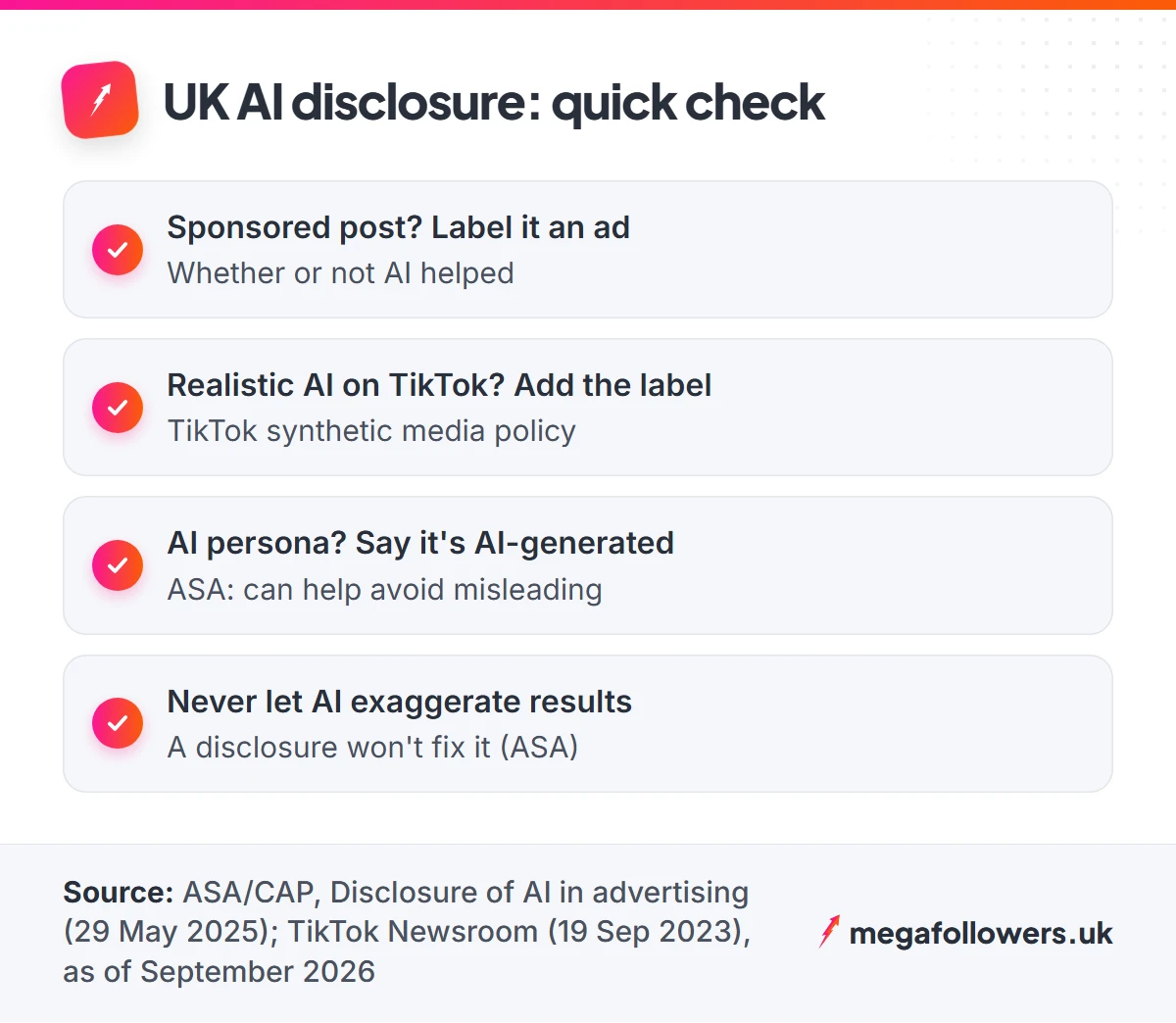
The rules differ by platform and by whether the post is an ad. TikTok's synthetic media policy requires creators to label AI-generated content that contains realistic images, audio or video, and TikTok added a dedicated AI-generated label in September 2023 to make that easy.
Advertising adds a second layer. In May 2025 the UK's advertising regulator said there is no blanket legal requirement in the UK to disclose AI in ads, but its existing rules still apply whether a person or a machine made the content. It gave one clear example: an AI image showing a cosmetic product's effect that doesn't reflect real results is likely to mislead, and an AI disclosure won't fix that.
- Sponsored post using AI? Label it as an ad as usual, and never let AI exaggerate what the product does.
- Realistic AI face, voice or scene on TikTok? Switch on the AI-generated label.
- AI for editing, captions or clean-up? In ads, the ASA treats minor edits that don't mislead much like any other retouching, with no automatic disclosure needed.
- Fully AI-generated persona? Say so. The ASA noted that making clear an influencer is AI-generated could help avoid a misleading impression.
A simple weekly AI workflow
Here's how the pieces fit into one week. Swap the days to suit your schedule; the order matters more than the timing.
| Day | Task | AI's job | Your job |
|---|---|---|---|
| Monday | Pick topics | Surface searched topics and angles | Choose the ones only you can film |
| Tuesday | Write | Draft hooks, outlines and captions | Rewrite in your own voice |
| Wednesday | Film | Nothing | Record one long take or a batch of short ones |
| Thursday | Edit | Split, reframe and caption clips | Check every cut and caption |
| Friday | Publish | Translate your best Reel | Add labels where the rules need them |
| Weekend | Engage | Draft saved replies | Reply personally and note new ideas |
Notice that filming has no AI job at all. Your face, your voice and your opinions are the part followers come back for, and that's worth protecting.
AI makes the content. Social proof makes it land.
AI has cut the cost of making content close to zero, which means standing out now depends on what viewers see around it. Learn how distribution works in our guide to how the TikTok algorithm works, and time your uploads with our best time to post on Instagram guide.
When you want that head start, every Mega Followers order uses real-looking accounts, never asks for your password and comes with at least a 30-day refill guarantee. Our FAQs answer the common questions.
AI and influencer FAQs
Can AI grow my followers on its own?
No. AI can plan, draft, edit and translate your content, but followers come from real people choosing to follow you. What AI does well is help you post more often and in more languages, which gives more people the chance to find you and hit follow.
Do I have to label AI content on TikTok?
Yes, if it's realistic. TikTok's synthetic media policy requires creators to label AI-generated content that contains realistic images, audio or video. The simplest way is the AI-generated label TikTok added in September 2023, although a caption or sticker disclosure also works under its guidance.
Is it legal in the UK to use AI in sponsored posts?
Yes. There's no blanket legal requirement in the UK to disclose AI in ads, according to the ASA's May 2025 guidance, but the advertising rules still apply. A sponsored post must still say it's an ad, and AI must not create a misleading impression of what a product does.
Which AI tools are free for influencers?
Free platform tools cover most needs. TikTok offers Creator Search Insights, AI Outline and Smart Split, with availability that varies by region. Meta offers AI translations for Reels on Instagram and Facebook, open to all public Instagram accounts where Meta AI is available.
Can AI reply to my Instagram DMs?
Partly. Meta's AI Studio let creators build an AI to answer common DMs, but since August 2026 nobody can create new AI characters or edit existing ones. Saved replies and a pinned FAQ comment cover most repeat questions without handing your voice to a bot.
Will AI replace influencers?
Unlikely for creators with a real personality behind the account. AI can generate polished content at scale, which makes a recognisable face, voice and opinion rarer and more valuable. The creators who gain most use AI for the grunt work and keep the human parts for themselves.