Why Social Media Is Important in 2026 and 2027: What the UK Data Shows
Why social media is important in 2026 and 2027: Ofcom's UK figures on usage, the drop in posting, AI search and the under-16 ban due in spring 2027.
In this article
Quick answer: Social media matters because almost everyone still uses it: Ofcom's 2026 report found 89% of UK adult internet users on at least one platform. Fewer people post, though, so active accounts win more attention. In spring 2027, a ban for under-16s arrives, which will change who scrolls UK feeds.
Most articles on why social media is important in 2026 and 2027 recycle global stats and upbeat predictions. The UK picture is more interesting, and a little awkward.
People haven't left. They've gone quiet, with far fewer posting than two years ago, and a government ban for under-16s is due in 2027. This guide uses Ofcom and gov.uk data to show what that means for brands and creators.
Why social media is important in 2026 and 2027: the UK numbers
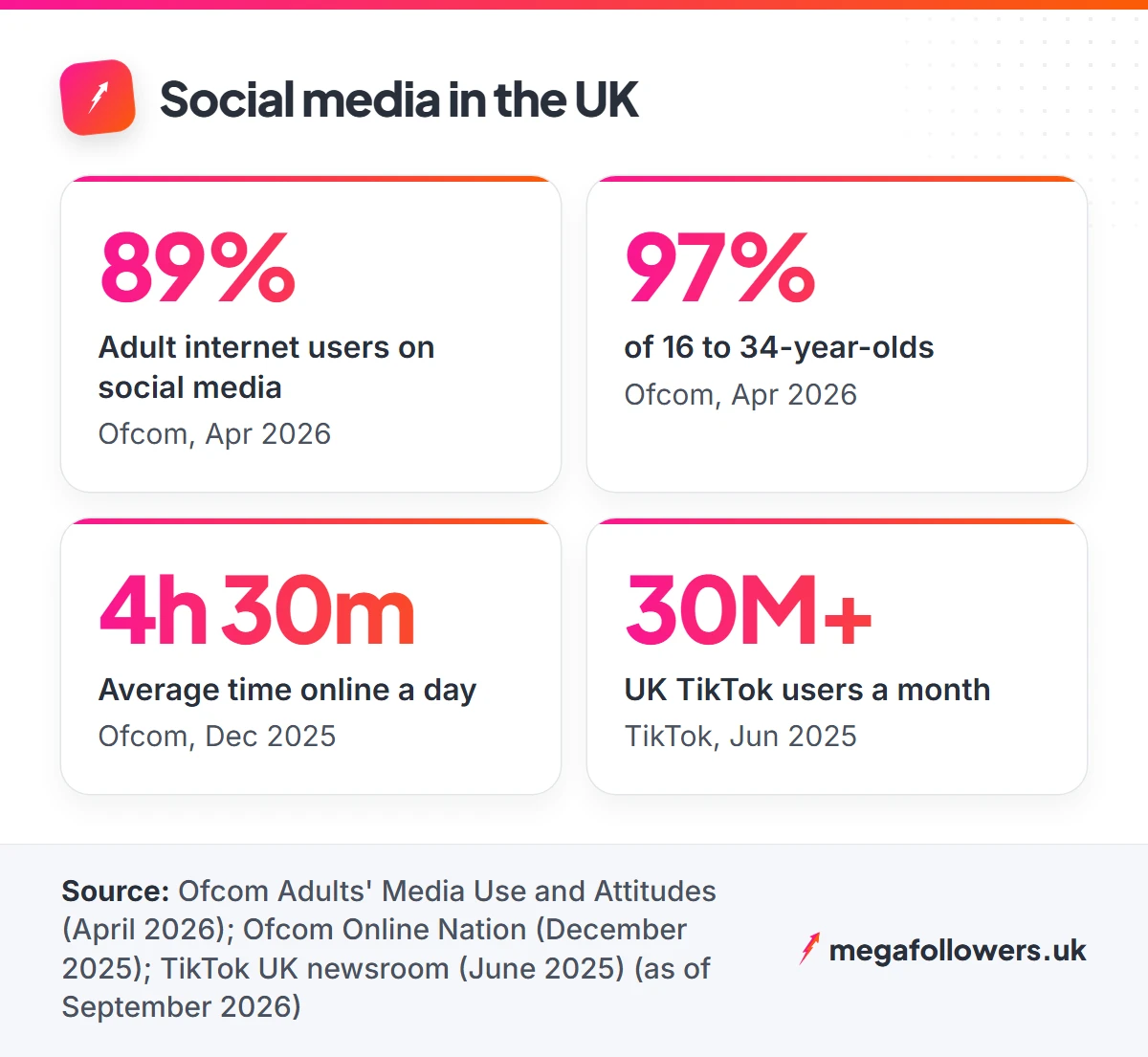
Social media is important because it remains the default place UK adults spend their online time. Ofcom's Adults' Media Use and Attitudes report, published in April 2026, found that 89% of adult internet users use at least one social platform. Among 16 to 34-year-olds, it's 97%.
Time online keeps rising too. Ofcom's Online Nation report, published in December 2025, puts the average adult at four and a half hours a day, ten minutes more than a year earlier, with most of it on a smartphone.
| Measure | Figure | Source |
|---|---|---|
| UK adult internet users on at least one social platform | 89% | Ofcom, April 2026 |
| UK 16 to 34-year-olds on social media | 97% | Ofcom, April 2026 |
| Average time online per adult per day | 4 hours 30 minutes | Ofcom, December 2025 |
| UK adults using YouTube | 94% (51 minutes a day) | Ofcom, December 2025 |
| UK adults using Facebook or Messenger | 93% | Ofcom, December 2025 |
| People in the UK using TikTok each month | 30 million+ | TikTok, June 2025 |
| Daily users across Meta's apps worldwide | 3.60 billion | Meta, July 2026 |
Two numbers on that list come from the platforms themselves. TikTok's UK newsroom put its UK audience above 30 million monthly users, averaged over early 2025. And Meta's second-quarter 2026 results reported 3.60 billion daily active people across its apps in June 2026, up 3% on a year earlier.
Treat platform figures with a little caution, since each company counts its users its own way. Independent research from Ofcom is the fairer guide to how the UK actually behaves.
The scale holds. What changed is how people use it.
People post less, but they still watch
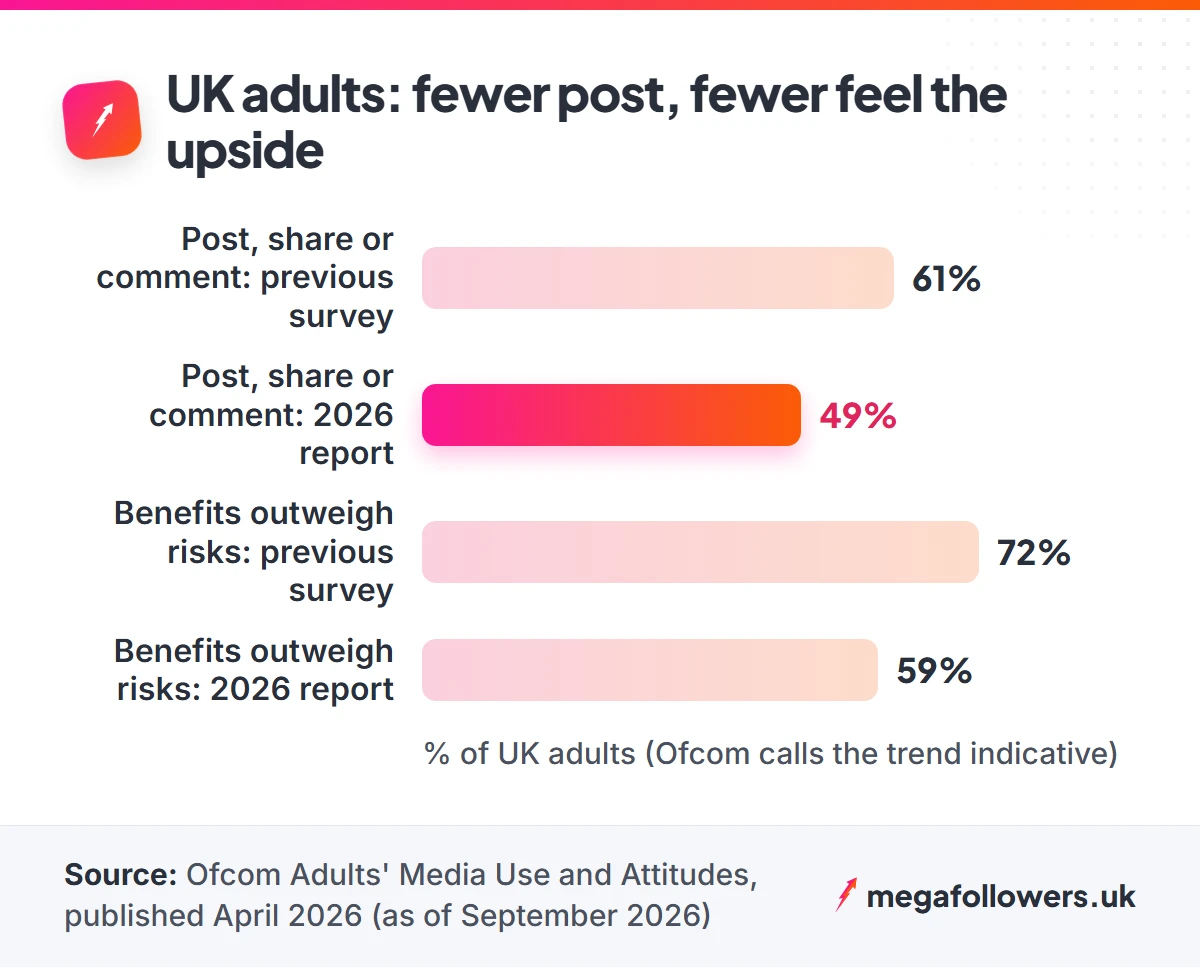
The biggest shift in 2026 is silent. Ofcom found that 49% of adult social media users now actively post, share or comment, down from 61% in 2024. Ofcom calls the year-on-year trends indicative, because it changed its survey method.
What most guides get wrong: several "why social media matters" articles say people are moving from passive scrolling towards more interactive, hands-on use. Ofcom's April 2026 findings point the other way for UK adults: use stays near-universal while posting drops.
Why the retreat? Caution plays a big part. Some 49% of adults now fear their posts could cause them problems later, up from 43%, and people in Ofcom's interviews described swapping permanent grid posts for Instagram Stories that disappear after a day.
That quiet majority still watches, and it judges accounts on what it can see at a glance: follower counts, likes and whether anyone is talking in the comments. Lurkers rarely leave a comment to vouch for you. So the visible numbers do that job instead, which is why a credible base of Instagram followers or TikTok followers carries more weight in a feed full of silent scrollers.
Fewer people posting also means less competition for the same attention. The accounts that keep showing up get a bigger share of it.
There's a flip side. Comments and shares used to give brands a lot of free promotion, and fewer people now hand them out. Your content has to earn attention through views and saves, and your profile has to convince visitors who will never ask a question.
Social feeds now do part of search's job
Search is changing underneath everyone. Ofcom's December 2025 report found that about 30% of searches now show an AI overview, and 53% of adults say they see these summaries often.
For a small business, that means a website ranking on its own can bring fewer clicks when a summary answers the question first. Social profiles fill the gap. People look up a café, a salon or a skincare brand on Instagram and TikTok to see real posts, recent comments and how busy the account looks before they visit.
Take a typical example. Someone types "best brunch in Bristol", reads an AI summary that names three places, then opens Instagram to see which one looks busiest. The profile, more than the website, decides where they book.
AI tools are spreading fast as well. Ofcom's April 2026 report found that 54% of UK adults now use tools such as ChatGPT, Copilot or Gemini. Chatbots answer questions. They don't show a busy comment section, a real customer's video or last week's specials, and that's what social profiles still do best.
The practical takeaway is short. Treat your profiles as a second homepage, and keep the bio, opening hours, prices page link and latest posts as current as the website itself.
Five reasons social media matters for UK businesses
These five reasons apply whether you run a one-person shop in Leeds or a national brand. Each ties back to how UK audiences behave in 2026, and together they explain why businesses that cut social media to save time usually end up paying for it in lost enquiries.
1. It's where customers discover you
Platforms decide what new people see, based on what they watch. A good Reel or TikTok can reach thousands of strangers in your area without an ad budget, which no leaflet drop or local paper advert can match for cost.
Location tags and local references help the right people find you. One strong post can keep collecting views for weeks. For example, a florist's 20-second video of a wedding arch going up can reach couples across the county long after the wedding itself.
2. It proves you're real and active
Before buying, people check whether a business looks alive. An account with recent posts, genuine comments and a healthy follower count reassures them. On Facebook, which 93% of UK adults use alongside Messenger, a page with solid Facebook page likes signals that other people already trust you. Empty accounts do the opposite: a last post from 2023 tells people the shop may have closed.
3. It sells directly
TikTok says more than 1.5 million British businesses use its platform, and TikTok Shop lets people buy without leaving the app. Instagram product posts and Facebook shops do similar work. The gap between seeing and buying has never been shorter. It also turns your comments into a shop floor, so answer sizing and delivery questions quickly.
4. It handles customer service in public
A quick, friendly reply to a complaint shows every future customer how you treat people. Silence shows them too. Reply within the day, move personal details to DMs and never argue in public, because people screenshot everything.
5. It gives you a cheap testing ground
Test three versions of an offer. Post each one and watch which earns saves and shares; you'll learn in a week what a printed campaign would take a quarter to reveal. For news-led or B2B audiences, an active X (Twitter) presence with a credible base of X followers does the same job in real time. Fast feedback, tiny cost.
What changes in 2027: the under-16 social media ban
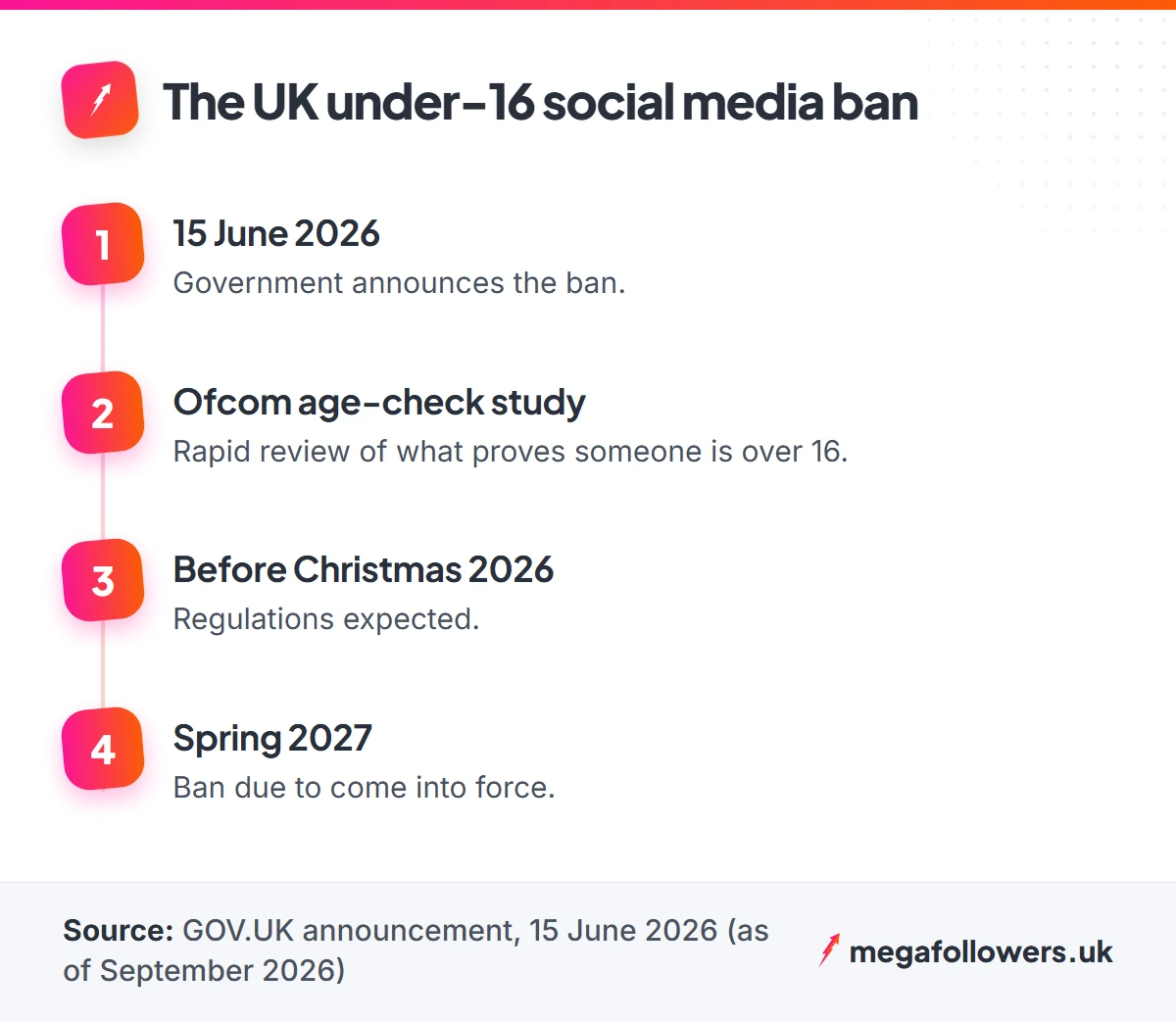
On 15 June 2026, the UK government announced that it will ban social media for under-16s, with the rules due to come into force in spring 2027. The gov.uk announcement names Snapchat, TikTok, YouTube, Instagram, Facebook and X among the platforms in scope.
The detail matters for anyone marketing online. Five points stand out:
- Messaging services such as WhatsApp and Signal sit outside the ban.
- Education services, e-commerce platforms and music streaming are exempt.
- Livestreaming and contact from strangers face extra limits for under-16s on wider services, including gaming.
- Ofcom will run a rapid study on which age checks work for proving someone is over 16.
- The government expects to publish the regulations before Christmas 2026.
Over 116,000 responses came in during the consultation, and the government says nine in ten parents back a ban. Expect it to happen.
Regulations will set the final rules, so details could still shift before spring 2027. Watch for Ofcom's age-assurance findings too. They'll show how platforms must check ages, and how much friction older teens and adults may face at sign-up.
What does it mean for you? If your audience skews young, your reachable UK audience on these apps shrinks from spring 2027, and age checks may add friction for 16 and 17-year-olds too. Brands aimed at adults lose little. Either way, plan your 2027 content around people aged 16 and over.
If you sell to families, speak to parents directly. They already use these apps, they approve most teenage purchases, and the ban leaves them squarely in your reach.
Why social media still matters in everyday life
For individuals, the reasons go beyond marketing. Ofcom's Online Nation research found that 72% of 13 to 17-year-olds who use social and messaging apps say those apps help them feel closer to friends. Adults use them to keep up with family, find local events and, increasingly, to earn a little on the side.
The downsides are real, and people know it. In Ofcom's 2026 survey, 59% of online adults felt the benefits of being online outweigh the risks, down from 72%. Two-thirds (67%) admit they sometimes spend too long on their devices.
That tension explains the quieter behaviour. People haven't quit; they've become choosier about what they post and who they follow, which rewards accounts that feel useful, trustworthy and worth the scroll.
Skills lag behind habits, though. Ofcom found that 89% of adults feel confident online, yet fewer feel sure they can recognise advertising (81%) or judge whether information is accurate (72%). That gap is why clear labels and honest profiles earn trust, and why a messy or misleading account loses it fast. Ofcom's long-running Media Lives interviews also found people using Facebook to set up small retail ventures.
How to make social media work for you in 2026 and 2027
Use the UK trends above as a checklist, with each step answering one of the shifts in Ofcom's and the government's data. Start at step one.
- Post consistently while others go quiet. Fewer active posters means your updates face less competition in followers' feeds. Three good posts a week beat ten rushed ones.
- Use Stories for the relaxed stuff. Some of Ofcom's interviewees prefer posts that disappear, so behind-the-scenes content fits there. Save the polished posts for the grid.
- Make your profile work like a homepage. Clear bio, pinned posts, opening hours and links, because many people now check profiles before websites.
- Build visible social proof. Silent visitors judge by counts and comments, so make both look healthy from day one, then keep them growing.
- Plan for a 16-plus audience. Review any campaign aimed at teenagers before spring 2027, and move that budget towards parents or older fans.
- Pick two platforms, then commit. Spread across five and every account looks half-finished. Choose the two where your customers already spend time.
- Label anything you're paid for. UK advertising rules expect a clear "Ad" label on paid and affiliate posts, and honest labels protect the trust you're building.
Measure one thing per platform each month. On Instagram that might be saves; on TikTok, average watch time. Daily swings mislead, whereas a monthly trend shows you clearly what's working and what to drop. Then change one thing at a time.
Visible numbers win the quiet scroll
Around half of your audience will never comment. They'll look at your numbers, make a snap judgement and either follow or move on, often without reading a single caption.
Those few seconds decide whether a visitor becomes a follower, a customer or neither. First impressions matter more than ever.
Mega Followers UK helps accounts look established from the first visit, with real-looking followers and Instagram likes from real-looking accounts, a 30-day refill guarantee and no password required. Then sharpen the rest: find the best time to post on Instagram, learn how the TikTok algorithm works and see why UK-targeted followers suit local businesses. Every order runs on your public profile link.
FAQ
Is social media still worth it for small businesses?
Yes. Ofcom's April 2026 figures show 89% of UK adult internet users on at least one social platform, so your customers are almost certainly there. Fewer people post than before, which leaves more room for businesses that show up consistently. A profile that looks active costs nothing to run beyond your time.
Which social media platform do most UK adults use?
YouTube, narrowly. Ofcom's Online Nation report from December 2025 found that 94% of UK adults use YouTube, spending 51 minutes a day on it on average. Facebook and Messenger together reach 93%, and WhatsApp reaches 90%. For short video, TikTok reports more than 30 million monthly UK users.
Will the under-16 ban include WhatsApp?
No. The government's June 2026 announcement says messaging services such as WhatsApp and Signal fall outside the under-16 ban. That ban targets platforms built for social interaction where users post material and algorithms serve content, including TikTok, Instagram, Snapchat, YouTube, Facebook and X. Rules are due in spring 2027.
Is social media bad for your mental health?
It depends on how you use it. In Ofcom's 2026 survey, 36% of social media users said the platforms are good for their mental health, down from 42%. Two-thirds of adults admit they sometimes spend too long on their devices. Setting time limits and following fewer, better accounts helps many people.
Will AI chatbots replace social media?
Not on current evidence. Ofcom found that 54% of UK adults now use AI tools, while 89% of adult internet users still use social media. People use chatbots to get answers and social platforms to see real people, products and reviews. For brands, both matter, so keep your profiles active and accurate.
Does the under-16 ban affect businesses that sell to teenagers?
Yes, from spring 2027. Under-16s won't be able to use the main social platforms in the UK, so organic content and ads there won't reach them. Brands selling to teenagers should shift towards audiences aged 16 and over, parents and channels outside the ban's scope, such as their own website and email.