Instagram Algorithm 2026: How It Works for Reels, Feed and Explore (and What Changes in 2027)
How the Instagram algorithm works in 2026, from Instagram's own ranking docs: Reels, Feed, Explore and Stories signals, the 2026 changes and 2027 outlook.
In this article
Quick answer: The Instagram algorithm is really five ranking systems, for Feed, Reels, Stories, Explore and Search. In 2026 they rank posts mainly on watch time, likes and sends (shares by DM), according to Instagram's head Adam Mosseri. Instagram recommends original content to non-followers and holds back reposts, generic hashtags and Reels over 3 minutes.
One Reel can reach tens of thousands of people while the next, posted the same way, stalls at a few hundred. Nobody at Instagram sends you a note explaining why.
Most guides fill that gap with invented percentages, perfect posting times and shadowban theories. This one sticks to what Instagram and Meta have published: the signals Instagram's boss named, Meta's ranking documents, the 2026 changes with their real dates, and what's already scheduled for 2027.
How does the Instagram algorithm decide what you see?
There isn't one Instagram algorithm. Adam Mosseri, who runs Instagram, has explained since 2023 that Feed, Stories, Explore, Reels and Search each use their own ranking system, built around how people use that part of the app. A post can do well in Feed and badly in Reels, because different systems judge it.
Each system works like a funnel. Meta's ranking card for Explore, updated in June 2026, describes the steps: the system gathers up to 1,500 possible posts, a first ranking pass cuts them to the top 100, and a second pass orders those by how likely you are to act on each one. Its predictions include liking, saving, resharing, commenting, following the author, watching more than 95% of a video and tapping "Not interested".
So the algorithm doesn't score your post in isolation. It predicts what each viewer will do with it, one person at a time, which is why the same post can fly with one audience and sink with another.
Three predictions matter most. In a January 2025 post, Mosseri named watch time, likes and sends as the three signals that count most, and pointed creators to three numbers in Insights: average watch time, plus likes and sends measured against reach. He added a nuance. Likes carry slightly more weight with your followers, while sends (sharing your post in a DM) carry slightly more weight with people who don't follow you yet.
Mosseri frames all of this as two kinds of reach. Connected reach means your followers, who mostly meet your posts in Feed and Stories. Unconnected reach means everyone else, found mainly through Reels and Explore. Most growth comes from the second kind.
That split makes sense. Followers already know you, so a like is a fair test of whether they enjoyed a post; a stranger who sends your post to a friend is telling Instagram it deserves a wider audience. Instagram's Creators team said in February 2025 that people reshare Reels more than 4.5 billion times a day across Instagram and Facebook.
Ranking is also getting better at reading posts. Meta told investors in July 2026 that it's building large language models into its recommendation systems, and its card for Feed recommendations already lists a post-quality score generated purely by an LLM.
Scale explains why this matters. Instagram passed 3 billion monthly users in October 2025, and Meta reported 2 billion daily users in July 2026. Every one of those feeds is personal, so two creators rarely see the same results from the same tactic.
How each surface ranks posts: Feed, Reels, Stories, Explore and Search
Each surface is chasing a different goal. Feed and Stories serve people who already follow you, while Reels and Explore exist to put you in front of strangers.
| Surface | Who sees it | Signals Instagram names | What you control |
|---|---|---|---|
| Feed | Followers, plus recommended posts | Your past activity, post popularity, the poster, your history with them | Posts people stop on, comment on and send |
| Reels | Mostly non-followers | Watch time, full watches, reshares, likes, audio use | The first 3 seconds, length, originality |
| Stories | Followers | How often people view and react to your Stories, closeness | Replies, stickers, DMs |
| Explore | Non-followers | Post popularity, the viewer's Explore activity, history with you | Saveable, shareable posts |
| Search | Anyone searching | Text match with your username, name, bio, captions and hashtags | Keywords in your profile and captions |
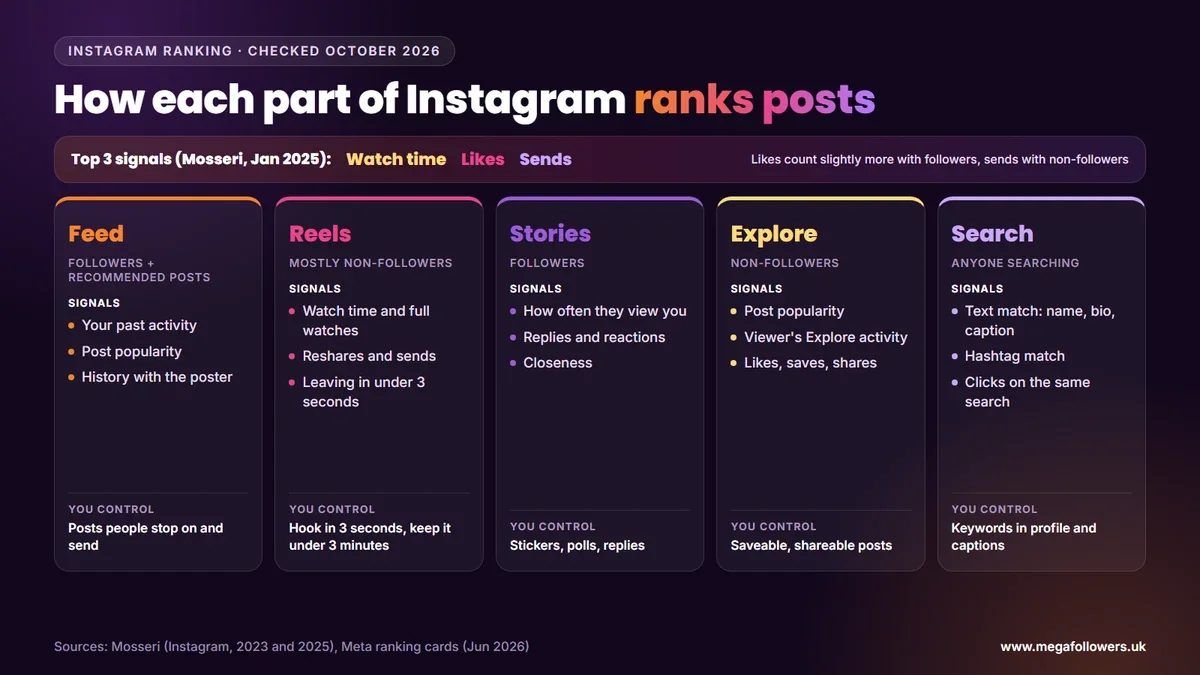
Feed
Feed mixes posts from accounts you follow with recommended posts from accounts you don't. Mosseri's 2023 explainer lists the signals in order: your activity, information about the post, information about the person who posted, and your history with them.
Meta's Feed card, updated on 29 June 2026, shows what the system predicts. It estimates whether you'll swipe a carousel to the last card, scroll past a post, send it to someone by DM, turn the sound on, or spend more than 10 seconds on the first post you see.
Freshness matters more than it did. Meta said in July 2026 that over half of all recommended Feed content is now less than a day old, more than double the share a year earlier.
You can also step outside the ranking. Following, a separate feed, shows accounts you follow in date order, and Favourites shows up to 50 accounts you pick, whose posts also rank higher in your main feed.
Reels
Reels is where most new reach comes from. Instagram's Creators team explained in February 2025 that a new Reel goes to your followers and to a small test audience of non-followers. If that group responds, the Reel moves on to a slightly wider audience, then a wider one again.
For Reels, Meta's card (November 2025) lists what each viewer's reaction feeds into: whether they leave in under 3 seconds, watch more than 95% compared with Reels of the same length, reshare, send it outside Instagram, comment, follow you or use your audio. Every one of those is a prediction about a single viewer.
Watch time drives those waves. Instagram's advice is to open with a hook in the first three seconds, then check view rate in Insights, meaning the share of viewers who keep watching past that point.
Length has a hard limit for reach. You can record Reels of up to 20 minutes, but the Help Centre says Instagram won't recommend Reels over 3 minutes to new audiences. Non-followers also see fewer low-resolution, watermarked, muted or bordered Reels, along with Reels that are mostly text or already posted on Instagram.
Stories
Stories rank by closeness. Instagram looks at how often someone views your Stories, how often they react or reply, and how close the two of you are on the app. Accounts you interact with most end up first in the row at the top of the screen.
That makes Stories the place to keep existing followers warm. Question stickers, polls and replies all count as interaction, and every reply lands in your DMs.
Explore
Explore is pure discovery, so a post's popularity carries more weight here than anywhere else. Explore also uses the viewer's own Explore history, any past interaction with you and how engaged your audience is. Likes, saves and shares are the actions it predicts most.
This is where the 1,500-to-100 funnel described above runs. Posts people want to keep, such as checklists, recipes and step-by-step carousels, suit a system that predicts saves. Negative signals count too, because a tap on "Not interested" teaches the system to show that viewer fewer posts like yours.
Search
Search runs on words. Meta's Search card (June 2026) ranks results partly on how closely a search matches a username, profile name, keyword or hashtag, and on how often people in the same country click a result after the same search. Put the words people search for in your name, bio and captions, since Mosseri has said keywords in comments don't help.
Public professional accounts run by adults can also appear in Google and Bing. Instagram lets search engines index public posts and Reels uploaded from 1 January 2020 on those accounts, and you can switch this off in your privacy settings.
People who find you through Search judge the profile before they follow. A newer account with a small following can look untested next to an established one, which is where Instagram followers give the profile first-impression social proof while your posts do the ranking work.
Instagram algorithm changes in 2026, with dates
Instagram made a run of ranking changes between December 2025 and October 2026. Here they are in date order, with what each one means for your posts.
- 18 December 2025: five-hashtag limit. Instagram began capping posts and Reels at five hashtags. Its @creators account said a few relevant hashtags work better than many generic ones, and that tags like #reels or #explore don't help content reach Explore. Spend your five on specific topics your audience actually searches.
- 10 December 2025 to 10 June 2026: "Your Algorithm". Instagram's Your Algorithm controls let people see and edit the topics shaping their recommendations. They launched on Reels in the US, reached Explore on 15 April 2026, and went live across Feed, Reels and Explore on 10 June 2026, "globally in English". Recommended Feed posts now carry interest labels such as "From Running", so a clear, consistent topic helps the system file you correctly.
- 30 April 2026: originality rules cover photos and carousels. Instagram's update for original creators extended the 2024 rules for reposted Reels to photos and carousels. Instagram says roughly three-quarters of recommendations in the US now come from original posts.
- 14 October 2025 onwards: 13+ default for teens. Teen Accounts in the US, UK, Australia and Canada moved to a 13+ content setting that keeps strong language, risky stunts and other mature posts out of teens' Explore, Reels and recommended Feed posts. Accounts that regularly post age-inappropriate content aren't recommended to teens either.
- June 2026: Meta's ranking cards updated. The public cards for Instagram Feed, Feed recommendations, Explore and Search were all refreshed between 22 and 29 June. They're the most detailed official description of Instagram ranking available.
- 14 July 2026: more languages for AI translations. Meta AI translations, which dub a Reel in your own voice, added French, German, Italian, Japanese and Korean on Instagram. That opens European audiences to UK creators who speak only English.
- 29 July 2026: Meta's Feed update. Meta said its largest single ranking improvement for Reels, which lifted reshares and time spent, is now coming to Feed. It also said people can type natural-language requests on the "Your Algo" page to tune what they see.
- 7 October 2026: carousels in Edits. Instagram's Edits app added a carousel editor that posts straight to Instagram, starting on iPhone.
Read together, these changes point one way. The app is rewarding original posts on a clear topic, giving viewers more say over what they're shown, and favouring content that's fresh and worth sharing.
Two older tools still shape 2026. Trial Reels (December 2024) let you test a Reel on non-followers first, and "Reset suggested content" (announced November 2024) lets anyone clear their recommendations across Explore, Reels and Feed.
What most guides get wrong: Several 2026 guides say Your Algorithm reached Explore in January; Instagram's announcement dates it to 15 April 2026. Others quote fixed percentages for each signal, such as sends being "worth" a set number of likes. Instagram has never published signal weights, and Mosseri described the balance only as "slightly more" for one or the other.
Why Instagram stops recommending your posts
Instagram has stricter rules for what it recommends than for what it allows. A post can stay up, reach your followers and still never appear in Reels, Explore or recommended Feed posts for anyone else.
Its Recommendations Guidelines spell out which content falls into that gap. None of it breaks the rules, but Instagram tries not to recommend:
- posts about self-harm, eating disorders or violence, and sexually suggestive images;
- posts promoting regulated products, weight-loss products or cosmetic surgery;
- unoriginal content repurposed from another source with only minor edits;
- long captions unrelated to the post, and coordinated comment networks used to push engagement;
- posts rated false by independent fact-checkers.
Some accounts lose eligibility altogether. Instagram's list includes accounts that recently broke its Community Guidelines, accounts banned from running ads, and accounts that keep posting photorealistic AI-generated people without the AI label.
Originality catches more creators than anything else on the list. Back in April 2024, Instagram said accounts that repost other people's content without real changes 10 or more times in 30 days would lose recommendations. Since 30 April 2026, the test is broader: an account that mostly posts unoriginal Reels, photos or carousels drops out.
Small edits don't rescue a repost. Adding a border, a watermark, subtitles or a credit in the caption doesn't make someone else's work original, though unique text that adds context, graphics with new information and remixes can count. Eligibility returns once most of your posts over a rolling 30-day window are original.
You can see where you stand in Account Status, in your settings. Professional accounts can check there whether their content and account are eligible for Explore, Reels, Feed recommendations, Search and suggested accounts, then remove posts or ask for a review.
Account Status shows examples of the posts that caused a problem, so you know exactly what to fix. The recommendation rules only govern what non-followers see from public accounts.
Teens see an even narrower set of recommendations. Under the 13+ setting, posts with strong language or risky stunts can still reach adult viewers, but Instagram won't recommend them to under-18s, which matters if your audience skews young.
Losing eligibility has a knock-on effect. Instagram also switches off Trial Reels for accounts that can't appear in recommendations, until eligibility comes back. Followers still see everything you post throughout.
Instagram algorithm myths vs what Instagram says
Plenty of algorithm advice comes from guesswork. Here's how the common claims compare with what Instagram itself has said.
| Myth | What Instagram says | Source |
|---|---|---|
| "Instagram shadowbans accounts" | The term has no shared meaning; Instagram says it doesn't hide content to push people towards ads. Check Account Status for real limits | Mosseri, May 2023; Help Centre |
| "There's a perfect time to post" | Timing is one of many signals; fresh posts are favoured, but no time rescues a post people skip | 2023 explainer; Meta, Jul 2026 |
| "More hashtags mean more reach" | Posts now take up to 5 hashtags; generic tags like #explore don't help | @creators, Dec 2025; Help Centre |
| "Delete and repost to reset a flop" | Reels already posted on Instagram get less visibility | 2023 explainer; Help Centre |
| "Engagement pods push posts up" | Coordinated comment networks are on the list of things Instagram won't recommend | Recommendations Guidelines |
| "Signals have fixed weights" | No weights published; likes count slightly more with followers, sends with non-followers | Mosseri, Jan 2025 |
| "Long Reels get pushed harder" | Reels over 3 minutes aren't recommended to new audiences | Help Centre |
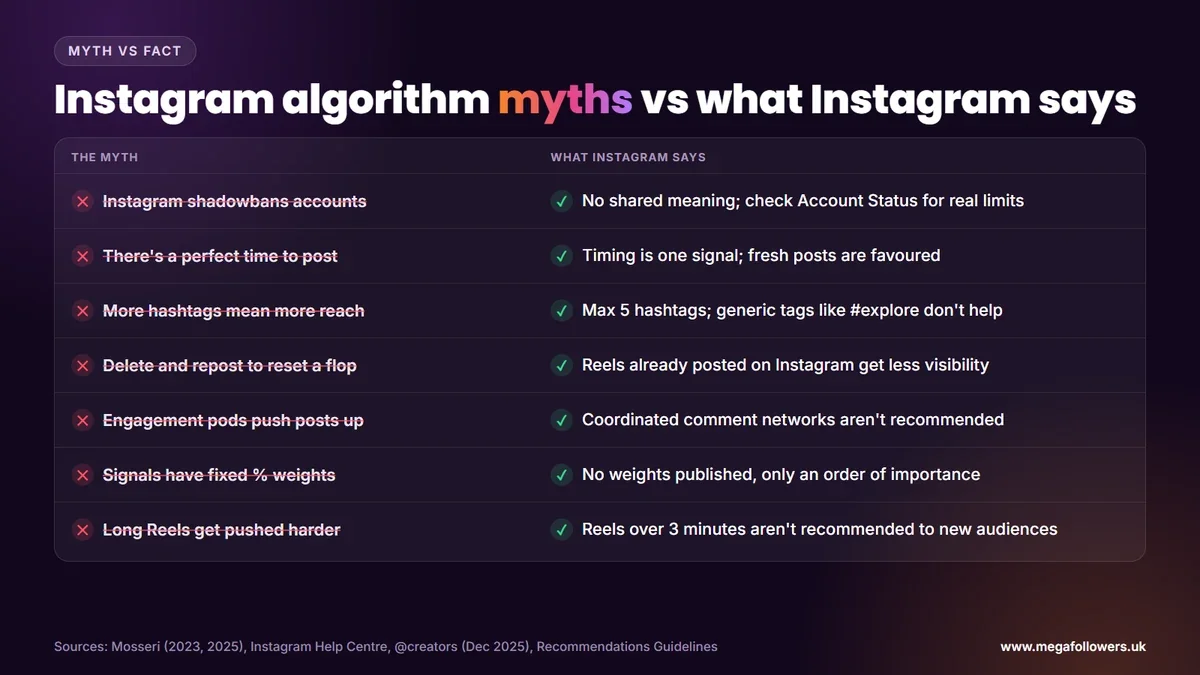 The shadowban myth survives because the real thing is invisible unless you look. Losing recommendation eligibility feels like a hidden penalty, yet Account Status shows it, names the posts behind it and offers a way back.
The fixed-weights myth is harder to shake, because a precise number sounds like insider knowledge. Instagram has only ever described its signals in order of importance, never as a formula. Any guide quoting a ratio between sends and likes is guessing.
Timing still has a place. Posting when your audience is online helps a post collect early reactions, and our guide to the best time to post on Instagram shows how to find your own window in Insights.
How to work with the Instagram algorithm: a 2026 checklist
Each step below maps to a signal Instagram has named. No tricks.
- Hook in three seconds. Open with the payoff, a question or movement, never a slow logo. Check view rate in Insights after every Reel, since it shows how many people stayed past the opening. If it drops, rework the first frame before anything else.
- Make it worth sending. Sends weigh most with non-followers, so give people a reason to share: a tip a friend needs, a joke about a shared experience, a local recommendation. Ask yourself who the viewer would send it to, and write the post for that person.
- Keep reach Reels under 3 minutes. Longer videos can live on your profile for followers, but only Reels of 3 minutes or less can reach new audiences through recommendations. Cut long tutorials into a short Reel that points to the full version.
- Post original work. Film it yourself, remove other apps' watermarks, and add real commentary or new information if you build on someone else's clip. Credit in the caption alone doesn't count.
- Use words people search for. Put keywords in your name, bio and captions, and pick 3 to 5 specific hashtags over generic ones. Our Instagram captions guide has examples by niche.
- Test with Trial Reels. Trial Reels go to non-followers first and don't affect your standard Reels. You need a public account with at least 200 followers on a professional account, or 1,000 on a personal one.
- Check Account Status monthly. A flagged post can quietly cut your recommendations; Account Status shows it and lets you appeal. Check it before you spend money promoting a post.
- Post regularly, and add audio. Instagram's own advice is to post consistently, and audio on photos and carousels can help them reach more people. A steady schedule also gives the system more evidence about who your posts suit.
If reach drops suddenly, work through it in order. Check Account Status first, then view rate on your last few Reels, then sends and saves against reach. One of them usually shows where it started.
Steps 1 and 2 do most of the work, because they feed watch time and sends directly. For more ways to earn reactions on each post, from caption prompts to Story stickers and comment replies, see our guide on how to get more Instagram likes.
What changes for the Instagram algorithm in 2027?
Meta has already set the direction. On its July 2026 earnings call, finance chief Susan Li said Meta sees "further headroom to continue improving recommendations over the rest of the year and into 2027". The plans she listed were more personalised recommendations, faster responses to trends and less low-quality content.
Language models sit at the centre of that work. Meta says LLMs give its systems a better grasp of what a post is about and what each person wants, and the "Your Algo" page already accepts typed requests. Expect captions, on-screen text and a clear topic to matter more as these systems spread.
That also changes how people steer their own feeds. Someone who types "more home workouts, fewer celebrity clips" into the Your Algo page is telling the system exactly which posts to send, so posts that state their subject plainly have the best chance of matching those requests.
UK users face their own changes. On 15 July 2026, the government said that a social media restriction for under-16s will take effect in spring 2027, with the first regulations laid before Parliament by the end of 2026. Sixteen- and 17-year-olds will have personalised feeds and autoplay switched off by default, plus an overnight curfew, though they can change these settings and no start date has been set yet.
Teen protections are already live. Ofcom's children's codes under the Online Safety Act have applied since 25 July 2025, requiring platforms to stop their algorithms pushing harmful content to children. Instagram's Teen Accounts, rolled out in the UK from September 2024, now default to a 13+ content setting that teens can't leave without a parent.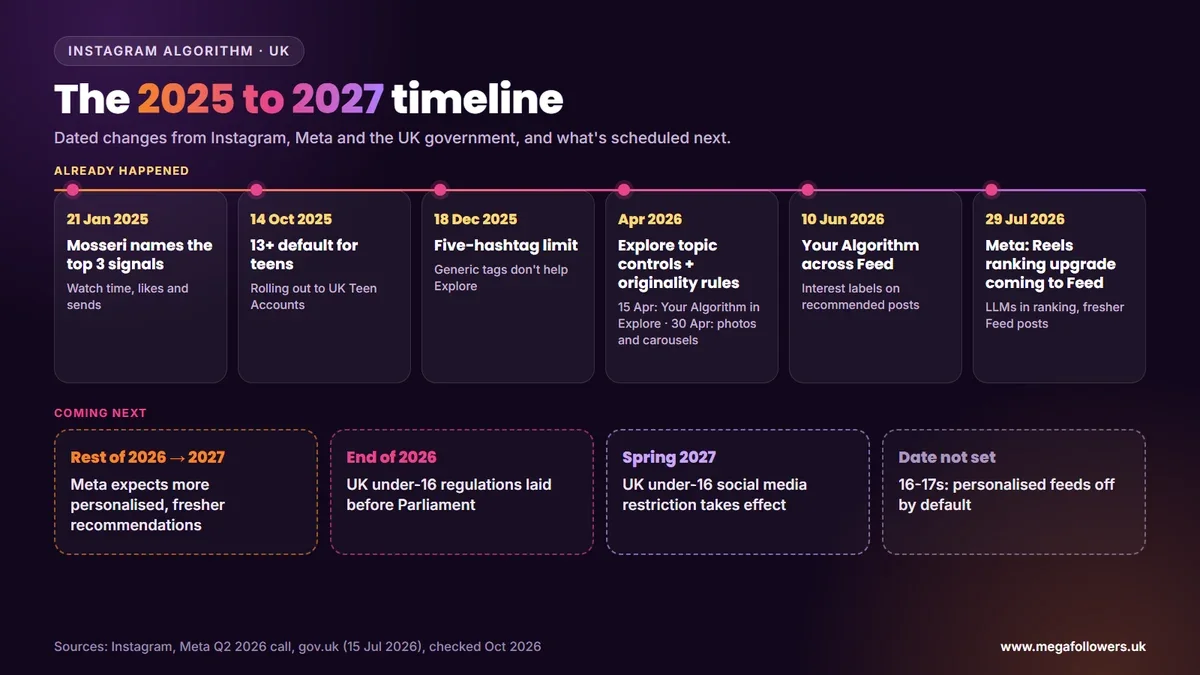
Three moves will hold up whatever ships next. Write captions that say plainly what the post is about, keep your account eligible for recommendations, and build Reels that people finish and send.
Our view: for UK accounts aimed at adults, 2027 should bring smarter ranking more than new rules. The safest bet is content that would earn a follow from someone who has never heard of you. Accounts aimed at under-18s should expect a smaller, more filtered audience. If you also post on TikTok, our guide to how the TikTok algorithm works covers the same ground for that app.
The algorithm decides who sees it. Your profile decides who stays.
Ranking gets your Reel in front of new people. What they see when they tap through to your profile decides whether they follow, buy or message, and that decision takes seconds.
A profile with a few dozen followers and quiet posts looks untested, even when the content is good. Mega Followers UK helps newer accounts look established while the content does the ranking work.
UK Instagram followers come from real-looking UK-based accounts. That suits shops, salons, trades and agencies selling to British customers, who tend to check a profile's numbers before they get in touch.
For individual posts, Instagram likes and Instagram Reel views give new uploads a visible start. No password needed.
Our 30-day refill guarantee covers your followers, likes and views. Pair it with original Reels, a strong opening and a profile full of searchable keywords, and new visitors have fewer reasons to leave.
Frequently asked questions
How do I reset my Instagram algorithm?
Use "Reset suggested content" in your settings, which clears your recommendations across Explore, Reels and Feed so they rebuild from fresh activity. You can also open "Your Algorithm" to add or remove topics, and tap "Not interested" on posts you don't want. Recommendations then retrain based on what you watch and engage with next.
Do hashtags still work on Instagram in 2026?
Yes, but with limits. Since December 2025 posts can carry up to five hashtags, and the @creators account says a few relevant tags work better than many generic ones. Hashtags help Search and hashtag pages sort your post. Tags like #reels or #explore don't help content reach Explore, so pick specific ones.
Is Instagram shadowbanning my account?
Probably not in the way people mean. Mosseri has said "shadowban" has no shared definition, and that the app doesn't hide posts to push people towards buying ads. Posts or whole accounts can lose eligibility for recommendations, though, and professional accounts can check this in Account Status, then remove posts or request a review.
How long should an Instagram Reel be for reach?
Keep reach-focused Reels at 3 minutes or less. You can record Reels of up to 20 minutes, but the Help Centre says Reels over 3 minutes won't reach new audiences through recommendations. Longer Reels still reach followers. For most accounts, a tight Reel with a strong opening earns more watch time than a long one.
Does the time you post affect the Instagram algorithm?
Somewhat. Timing is one of many signals, and fresh content does better: over half of recommended Feed posts are now under a day old. Posting when your followers are online helps a post gather early reactions. No posting time can rescue content that people scroll past.
Can a small account go viral on Instagram?
Yes. Each new Reel goes to a small test audience of non-followers first, then to wider groups if it performs well. That gives small accounts a real chance on any single Reel. Strong watch time, sends and likes from that first audience matter far more than how long the account has existed.
What is the most important signal in the Instagram algorithm?
There isn't a single one. In January 2025 Mosseri named watch time, likes and sends as the three that matter most, with likes slightly more important among followers and sends among non-followers. For Reels, watch time underpins the rest, and leaving within three seconds is one of the outcomes Meta's Reels card predicts.
Does the Instagram algorithm work differently in the UK?
The ranking systems are the same, but UK rules shape what teens see. Teen Accounts default to a 13+ content setting, and the Online Safety Act's children's codes require algorithms to filter harmful content for under-18s. The government also plans an under-16 social media restriction for spring 2027.