Comparing Instagram, TikTok and Facebook Growth Ladders for Small Teams
Social media for small business, compared rung by rung: Instagram, TikTok and Facebook growth ladders, hours per week and which platform to start on.

In this article
Quick answer: For most UK small teams, social media for small business works best as one lead platform plus one support platform. TikTok climbs fastest from zero, Instagram turns reach into enquiries, and Facebook keeps hold of local and older customers. A team of two should master the first rungs of one ladder before adding a second.
A café owner with one part-time helper can't film TikToks, design Instagram carousels and run a Facebook group every single day. Plenty try anyway. The result is usually three half-run accounts, each growing more slowly than one account run properly would.
The fix is simple. Treat each platform as a ladder with clear rungs, a weekly time cost and a signal that says it's time to climb.
What a growth ladder is, and why small teams need one
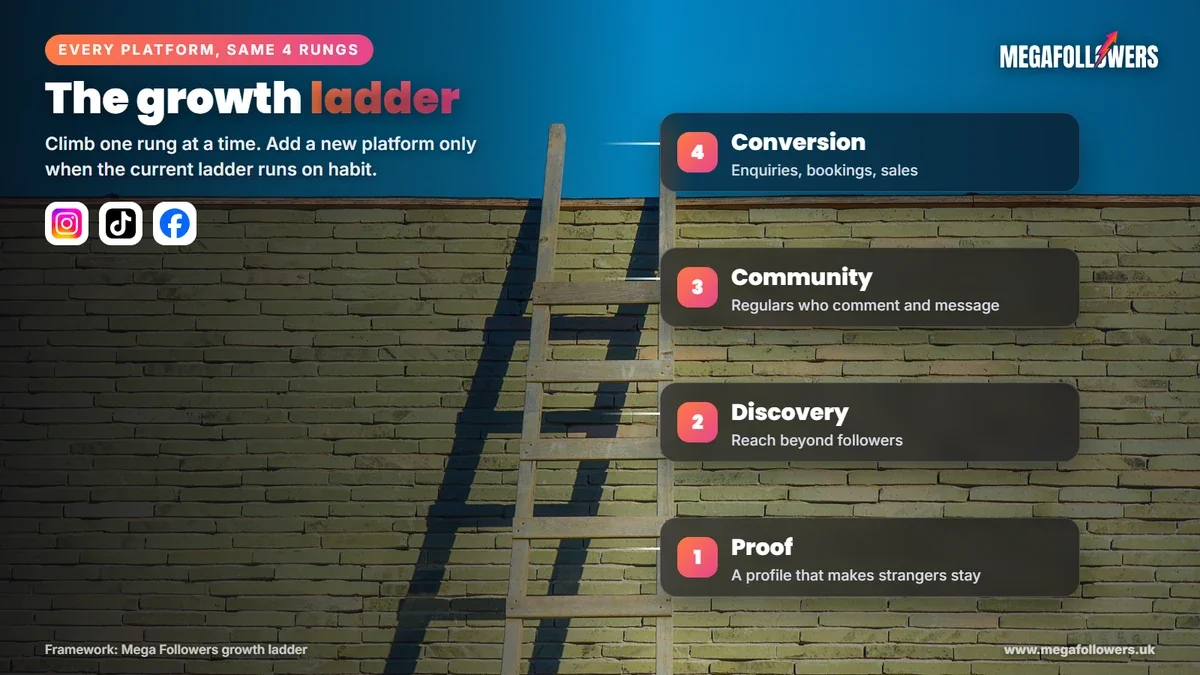
A growth ladder is the order in which an account earns trust, then reach, then regulars, then sales on one platform. Skipping a rung rarely works. A sales post shown to nobody sells nothing, and a viral video that lands on an empty-looking profile wastes most of its views, because the people who tap through to the profile leave the moment they see three posts and a handful of followers.
Every platform has the same four rungs. Only the tools change:
- Proof: a profile that makes a stranger stay (bio, first posts, visible followers and likes).
- Discovery: content the platform shows to people who don't follow yet.
- Community: repeat viewers who comment, share and send messages.
- Conversion: enquiries, bookings and sales.
Social media growth stalls most often when a small team jumps to rung four while rung two still isn't working. That's how businesses use social media badly. The ladder view also settles the question owners ask most, which is when to add another app, and the answer is refreshingly dull: add one only when the current ladder runs on habit.
TikTok vs Instagram vs Facebook at a glance
TikTok is a discovery engine, Instagram is a shop window and Facebook is a community noticeboard. Three different jobs. That one line covers most of the difference between Instagram and TikTok, and most of the Instagram vs Facebook debate too.
| Platform | UK reach (Ofcom, 2025) | What drives discovery | First rung to climb | Best for |
|---|---|---|---|---|
| TikTok | Adult figure not given in Ofcom's 2025 summary | The For You feed, which shows videos to non-followers | Ten or so videos that show what the account is about | Fast reach from zero, younger buyers |
| Adult figure not given in Ofcom's 2025 summary | Reels for new viewers, Stories for regulars | A grid and bio that turn a visit into a follow | Turning reach into enquiries and repeat custom | |
| 93% of adults use Facebook or Messenger | Local groups, shares and Page recommendations | A complete Page with hours, services and reviews | Local services and older customers |
Ofcom's report on how the UK goes online in 2025 puts Facebook and Messenger at 93% of adults and YouTube at 94%. Reach isn't the same as attention, though. A platform almost everyone opens can still be the wrong place for a brand whose customers spend their evenings on short video.
Among the social media platforms for small businesses, no single app wins on every rung. That's why the ladders below matter more than the logos.
The Instagram ladder: from a trusted grid to Reels reach
Instagram rewards accounts that look established and post short video often. The ladder starts with the profile, because Instagram visitors judge a business by its grid before they watch anything.
Rung 1: a profile that turns a stranger into a follower
The first rung is a profile that answers three questions in a few seconds: what the business does, where it is and why someone should follow. A clear bio, three or four Story Highlights (menu, prices, reviews, location) and nine strong posts do most of the work, and a visitor who sees all three in place usually decides to follow before watching a single Reel.
Numbers count here too. A grid with 40 followers can make a good bakery look closed, even when its croissants are the best in town. Some owners buy Instagram followers as a small starter audience, so new visitors don't land on an empty-looking page while the content catches up. That only helps if the posts are worth following.
Rungs 2 and 3: Reels for reach, Stories for regulars
Reels are how Instagram shows a business to people who don't follow it yet. Stories, replies and DMs keep regulars coming back. Three Reels a week and a few Stories a day is plenty for a small team.
Switching to a free professional account adds Insights, so owners can see which Reels pull in new viewers and which fall flat. Instagram's guide to setting up a professional account covers the switch. For the ranking side, this guide to how the Instagram algorithm ranks posts explains what the feed rewards.
Rung 4: enquiries and sales
This rung turns attention into money. Link stickers in Stories, a booking link in the bio, saved replies for common DMs and pinned posts with prices all shorten the path from a view to a sale. Small touches. Real money.
The TikTok ladder: why TikTok vs Instagram isn't a fair fight from zero
A brand-new TikTok account has a real chance of reach on day one, because the For You feed tests videos on viewers who have never heard of the business. That's why TikTok vs Instagram looks so lopsided for new accounts. Instagram leans harder on an audience the account already has.
How to use TikTok for business on day one
Step one is the account type. TikTok's Creator Academy article on business and personal accounts sets out the path:
- Open the profile and tap the three-line menu.
- Tap Settings and privacy.
- Tap Account.
- Choose Switch to Business Account and pick the category that fits the business.
Done. That's the whole switch to a business account on TikTok, and it costs nothing and needs no paperwork.
Paid promotion can come later through TikTok for Business, the company's ads and tools hub. In the meantime, a small team should post three to five short videos a week on one clear topic and answer good comments with video replies. Timing matters as well, and this guide on the best time to post on TikTok lists the UK windows.
Rungs 3 and 4: LIVE and the link in bio
The community and sales rungs open up as the follower count grows. According to the support page on what TikTok LIVE is, hosts must be 18 or over and need 1,000 followers to go LIVE, though this may vary by region. This guide on how many followers it takes to go LIVE covers the rules in full.
LIVE is where regulars turn into a community. It's also where a viewer's question about prices or delivery becomes an order, often within minutes.
Where TikTok stalls for small teams
Filming is the bottleneck. Trends move weekly, and a team that can't film three times a week will watch its reach fade, however good the first videos were. The UK audience also skews younger, so a will-writing firm may find its buyers elsewhere.
The Facebook ladder: Pages, groups and local trust
Facebook is the steadiest ladder for local businesses, because neighbours already use it to find trades, events, school fairs, lost cats and recommendations for a plumber who actually turns up. Using Facebook for business is less about going viral and more about being findable and trusted nearby.
How to make a Facebook business page
The first rung is a complete Page. Meta's help page on creating a Facebook Page walks through it, and the basics take minutes:
- Open the Facebook menu, go to Pages and choose Create new Page.
- Add the business name, a category and a short bio.
- Fill in opening hours, services, location, phone number, website and the area the business covers, because locals search for exactly those details.
- Add a profile photo and a cover image, then publish.
A Page with no likes looks unfinished to locals who find it through search. Some owners add a starter batch of Facebook page likes so the Page looks active while real reviews build up.
Rungs 2 to 4: groups, events and offers
Facebook for small businesses works best through local groups, where a helpful answer often wins more trust than an advert. It's slow. It works.
Events, Messenger replies and simple offers handle the community and sales rungs. Meta Business Suite can also post the same content to Instagram, which saves a small team real time.
The best social media for business for teams of 1, 2 or 3
The best social media for business is the one a team can run every week without burning out. Team size decides that. Trend reports don't.
| Team size | Lead platform | Support platform | Posts a week | Rough weekly hours |
|---|---|---|---|---|
| 1 person | Instagram or TikTok (whichever the customers use) | Facebook Page kept up to date | 3 short videos + daily Stories | 3 to 4 |
| 2 people | TikTok for reach | Instagram for enquiries | 4 videos, reposted to both | 5 to 7 |
| 3 people | TikTok + a Facebook group | 5 videos + 1 LIVE or group post | 8 to 10 |
Treat the hours as a rough planning guide, not research. They assume one batch-filming session a week plus short daily check-ins for comments and DMs.
Social media management for small business gets much easier once every task has a named owner, so one person films while another edits, schedules and replies. Small business social media management fails most often when nobody owns the replies. Customers notice. The importance of social media for businesses comes from those replies as much as from the posts themselves.
Social media marketing for small business on a budget: one video, three platforms
The cheapest way to run social media marketing for small business is to film once and publish natively three times. One vertical video, shot without on-screen watermarks, can work on TikTok, as a Reel on Instagram and in a Facebook post.
- Film in vertical 9:16 and save the clean file before adding app effects.
- Upload that file separately to each app, rather than downloading a watermarked copy from one and posting it to another.
- Change the first line of the caption and the opening hook for each audience.
- Post at each platform's best local time. This guide on the best time to post on Instagram has the UK windows.
The same file can later go to YouTube Shorts, so a team running Instagram, TikTok and YouTube spends one filming session instead of three. That's where most of the social media benefits for small teams come from. More reach, same filming day.
Where social proof fits in social media for small business
Social proof decides the first rung on every platform, because visitors judge numbers before they judge content. A new profile with real posts but tiny counts often loses the follow it deserves.
A boost helps here. Instagram likes help a strong post look as popular as it should.
On TikTok, TikTok views give a new video a fairer first impression, and a starter batch of TikTok followers stops a fresh profile looking empty. None of it replaces posting. It just stops good work going unseen.
FAQ: social media ladders for small teams
Which social media is best for a small business in the UK?
It depends on the customers: consumer brands selling to under-35s usually do best with TikTok for reach and Instagram for enquiries. Local services are different. Their customers tend to be older, and Facebook plus Instagram usually reaches them better than TikTok does. The best start is one lead platform, run well for three months, before adding a second.
Do more people use Instagram or TikTok in the UK?
Ofcom's 2025 summary doesn't give adult reach figures for either app. It lists YouTube at 94% of adults and Facebook with Messenger at 93% as the widest reaching. For a small business, a better test is where its own customers spend time, which Insights and customer chats reveal quickly.
Can you post the same video on TikTok and Instagram?
Yes, as long as each upload is a clean file without the other app's watermark. Instagram and TikTok both favour original-looking uploads. Teams usually keep the video the same but rewrite the hook, caption and hashtags for each platform, then post at each app's busiest local time.
Is Facebook still worth it for small businesses?
Yes, especially for local trade. Ofcom puts Facebook and Messenger at 93% of UK adults, and local groups remain one of the easiest places to earn word-of-mouth. A complete Page with hours, reviews and quick Messenger replies often brings steady enquiries without daily posting.
Can you build a business without social media?
Yes. Plenty of firms grow through search, referrals and marketplaces alone. Social media mainly makes discovery cheaper and gives buyers a way to check a business is real and active. Most still keep a basic profile so customers can check recent work and reviews.
How many hours a week does social media take for a small team?
As a rough planning guide, one person can run a lead platform in three to four hours a week with batch filming. Two people running two platforms usually need five to seven hours. Replies to comments and DMs take the most time, so assigning them to one person keeps things moving.