Best Time to Post on TikTok: UK Times for Every Day in 2026 and 2027
The best time to post on TikTok in the UK, day by day, from 25 million UK engagements, plus how to find your own peak in TikTok Studio and 2027 dates.

In this article
Quick answer: For a UK audience, the best time to post on TikTok falls on weekday afternoons and evenings, roughly 3pm to midnight, with your best video saved for Thursday. That's the pattern in Sprout Social's study of 25 million UK TikTok engagements. Global data from Buffer favours Saturday and Sunday mornings instead, so confirm your own peak in TikTok Studio.
You film a TikTok you're proud of, post it at lunchtime, and it stalls at a few hundred views. The next one, posted at 9pm, flies.
Most timing advice won't help you fix that, because it's based on American data or one global average. This guide gives UK times for every day of the week, shows where the two biggest studies disagree, and walks you through finding your own best slot.
When should you post on TikTok in the UK?
Post between 3pm and midnight on a weekday, and give Thursday your strongest video. Sprout Social analysed 25 million UK TikTok engagements on brand profiles for its UK posting-times study and found Thursday the best day and Saturday the worst. The study lists its UK times in GMT.
The UK pattern runs late. Engagement holds from 4pm to midnight on Mondays and Thursdays, and from 3pm to 11pm on Wednesdays. Friday and Sunday shrink to a single 10pm to 11pm slot, the last scroll of the night.
That matches the wider UK picture. Averaged across all six networks in the study, UK engagement peaked on Thursday afternoons and evenings, from 4pm to 11pm GMT, and Saturday came last on almost every platform.
Global data tells a different story. Buffer's study of 7.1 million posts found the best single slot was Sunday at 9am, followed by Monday at 1pm and Sunday at 1pm. It ranks Saturday as the best day overall. That's the day Sprout's UK data ranks last.
| Day | UK windows (Sprout Social, GMT) | Global top times (Buffer, best first) |
|---|---|---|
| Monday | 4pm to midnight | 1pm, 11am, 8am |
| Tuesday | 3pm to 8pm, 9pm to 11pm | 6am, 10pm, 7am |
| Wednesday | 3pm to 11pm | 10pm, 6am, 9pm |
| Thursday | 4pm to midnight | 1pm, 10pm, 6am |
| Friday | 10pm to 11pm | 6pm, 10pm, 8pm |
| Saturday | Midnight to 1am, 2pm to 8pm, 10pm to 11pm | 5pm, 4pm, 3pm |
| Sunday | 10pm to 11pm | 9am, 1pm, 12pm |
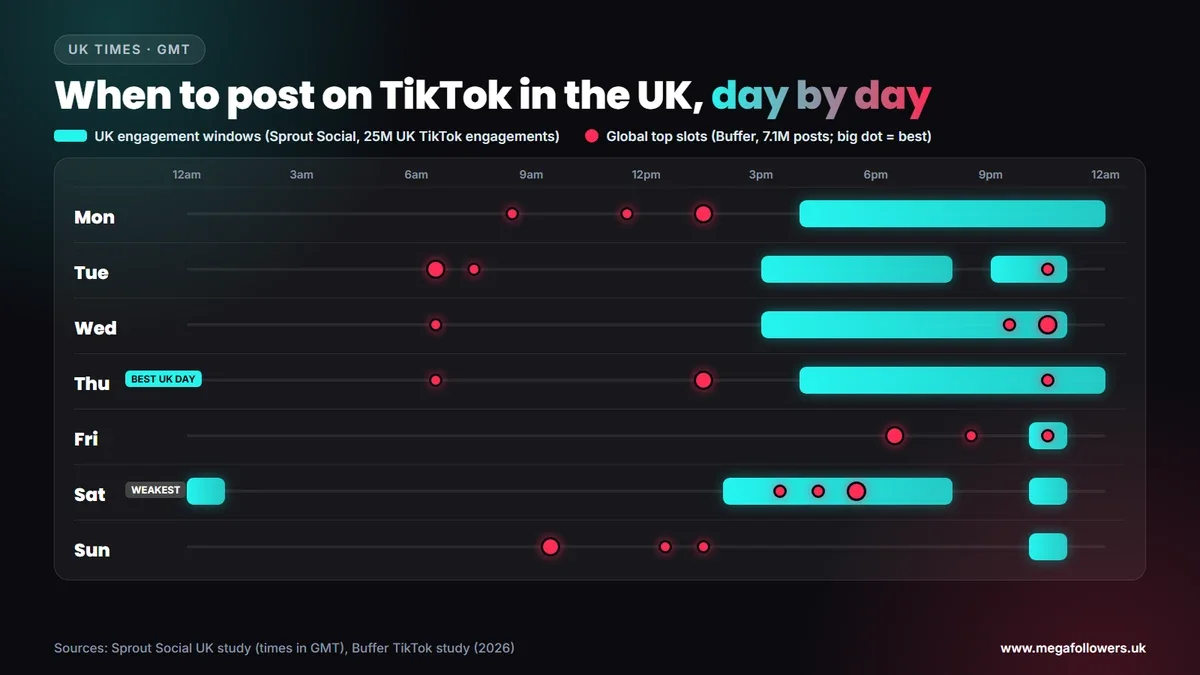 Use the UK column as your starting point if most of your followers are British. Treat the Buffer column as a second set of slots to test, especially at weekends.
Best time to post on TikTok each day of the week
Each day below gives the UK window first, then the global slot worth testing alongside it. All times are UK clock times.
Monday
Post between 4pm and midnight. Monday is one of Sprout's strongest UK days, with engagement holding right up to midnight, so an 8pm post sits in the middle of the window. Buffer puts Monday second overall worldwide, with 1pm its best slot. One lunchtime test is worth it.
Tuesday
Tuesday splits into two UK windows: 3pm to 8pm, then 9pm to 11pm. If you can only post once, aim for late afternoon, when the first window opens. Early risers are a different story. Worldwide, Buffer found 6am, 10pm and 7am the best Tuesday slots, so a breakfast-time post may suit an audience that scrolls before work.
Wednesday
Wednesday gives you the longest single UK window, 3pm to 11pm, which makes it the easiest day to fit around work or school. Both studies back a late post here: Buffer's best Wednesday slot is 10pm, which falls inside the UK window. Posting just once a week? Make it Wednesday or Thursday evening.
Thursday
Thursday is the strongest UK day in Sprout's data, with engagement running from 4pm to midnight. Save your best video of the week for it. Globally, the top Thursday slots were 1pm, 10pm and 6am, and 10pm again overlaps the UK window.
Friday
UK engagement on a Friday narrows to 10pm to 11pm. Earlier evening slots don't make Sprout's list at all. In the global data, 6pm leads, then 10pm, then 8pm, so 10pm is the slot both studies share.
Saturday
Saturday is the weakest UK day in Sprout's data, but it still has windows: just after midnight, 2pm to 8pm, and 10pm to 11pm. Here the studies clash hardest. Buffer ranks Saturday as the best day of the week worldwide, peaking at 5pm, then 4pm and 3pm. If a large share of your followers live outside the UK, test a Saturday afternoon post before you write the day off.
Sunday
Sunday in the UK data narrows to one late slot, 10pm to 11pm. The global picture is the opposite. Buffer's single best slot of the whole week is Sunday at 9am, with 1pm and midday close behind, so Sunday is the clearest case for testing both a morning post and a late one.
Why Buffer and Sprout Social disagree on TikTok times
They measure different people in different ways. Buffer's study, Best Time to Post on TikTok, from 7.1 million posts, looked at the median engagement rate of videos, carousels, photos and text posts published through Buffer by users around the world. Sprout's UK figures show where engagement clusters on UK brand profiles.
Method changes the answer. A median engagement rate measures how well a typical post performs in a slot, and a quieter slot with less competition can score well on it. A count of engagement tends to follow the hours when the most people are scrolling. In the UK, that means evenings.
The samples differ as well. Buffer doesn't tie its times to one time zone and presents them as a starting point wherever you live. Sprout's UK data comes from one country, so its hours follow a British day: work, the commute home, dinner, then the late scroll in bed.
Even Sprout's own studies differ by region. Its global TikTok guide, based on 2 billion social media engagements across 307,000 profiles between 27 November 2025 and 27 February 2026, put the best times at 2pm to 6pm, Tuesday to Thursday, in local time.
So which should you trust? For a UK account, the UK data comes first. Then borrow Buffer's strongest slots, especially Sunday morning and Saturday afternoon, as tests. Neither study knows your followers, which is why the final word belongs to your own analytics.
How to find your own best time in TikTok Studio
Your own data beats both studies, and TikTok gives it to you free. According to TikTok's Creator Academy guide, Introducing TikTok analytics (updated 7 October 2026), you can open analytics in three places:
- In the TikTok app: go to your profile, tap the menu bars, select TikTok Studio, then find Analytics and tap View all.
- On the web: open TikTok Studio and choose the Analytics tab on the left.
- In the TikTok Studio app: tap the Analytics tab in the bottom bar.
Two tabs answer the timing question. The Viewers tab has a "Most active times" section showing when your viewers were most active on TikTok in the last 7 days. The Followers tab breaks your audience's activity down by hours and days, alongside their age, gender and top locations.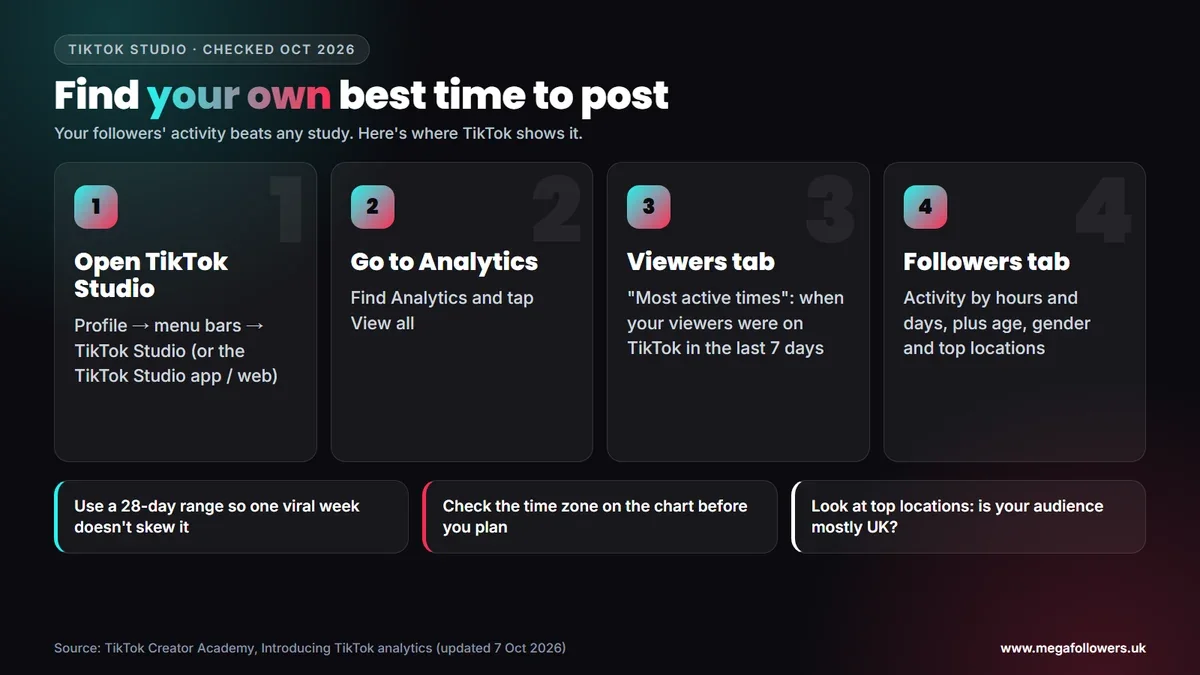
Set a longer date range before you decide anything. Analytics covers the last 7, 28, 60 or 365 days, or a custom range, and you can download up to 365 days of data at a time. A 28-day view smooths out a single viral week.
Then read the charts with two checks. First, look at the locations on the Followers tab: if a third of your audience sits in the US, your best UK slot may not be your best slot overall. Second, check the time zone shown on the activity chart, and convert to UK time if it doesn't match your local clock.
One more tab is worth a look. Overview shows your traffic sources and the search queries that led people to your posts. If a large share of your views comes from Search, posting time matters less for those videos, since people find them whenever they search.
Look for patterns across a few weeks rather than one spike. TikTok says viewer insights such as age and location come from predictive models rather than confirmed user data. Treat them as a strong guide, not an exact count.
Run a four-week posting test
A four-week test turns the studies and your analytics into a schedule you can trust. Pick three slots: one from your Follower activity peak, one from the UK study and one from Buffer's global list. Post similar videos in each, every week, and compare them after seven days.
Keep everything else steady. Post the same type of content in each slot, with similar lengths and hooks, so that the time of day is the main thing that changes from one post to the next. Then log these four numbers a week after posting:
- Views: the total after seven days.
- Average watch time: how long viewers stayed on average.
- Watched full video: TikTok's finish rate, the share of viewers who reached the last few seconds.
- New followers: how many people followed you from that post.
| Week | Slot tested | Post | Views after 7 days | Average watch time | Watched full video | New followers |
|---|---|---|---|---|---|---|
| 1 | Thursday 9pm (UK study) | Example: recipe video | ||||
| 1 | Sunday 9am (Buffer) | Example: recipe video | ||||
| 1 | Your follower peak | Example: recipe video | ||||
| 2-4 | Repeat with new videos |
By the end of week four you'll have four posts in each slot to compare. Judge each slot on watch time and new followers as well as views. A slot that brings viewers who finish your videos is worth more than one that brings a quick spike and a quick exit.
Then act on it. Move your main daily post to the winning slot, keep the runner-up as a second slot, and drop the loser. Run the test again every quarter, because audiences shift as an account grows.
GMT, BST and the clock change: the UK detail most guides miss
UK clocks go back an hour at 2am on Sunday 25 October 2026 and forward again at 1am on Sunday 28 March 2027, according to gov.uk's clock change dates. That affects how you read every posting time you find online.
Sprout labels its UK times GMT. That's easy in winter: from 25 October 2026 to 28 March 2027 UK clocks run on GMT, so every time reads exactly as listed. While British Summer Time is in force, a slot quoted in GMT shows an hour later on a UK clock, so 4pm GMT becomes 5pm BST.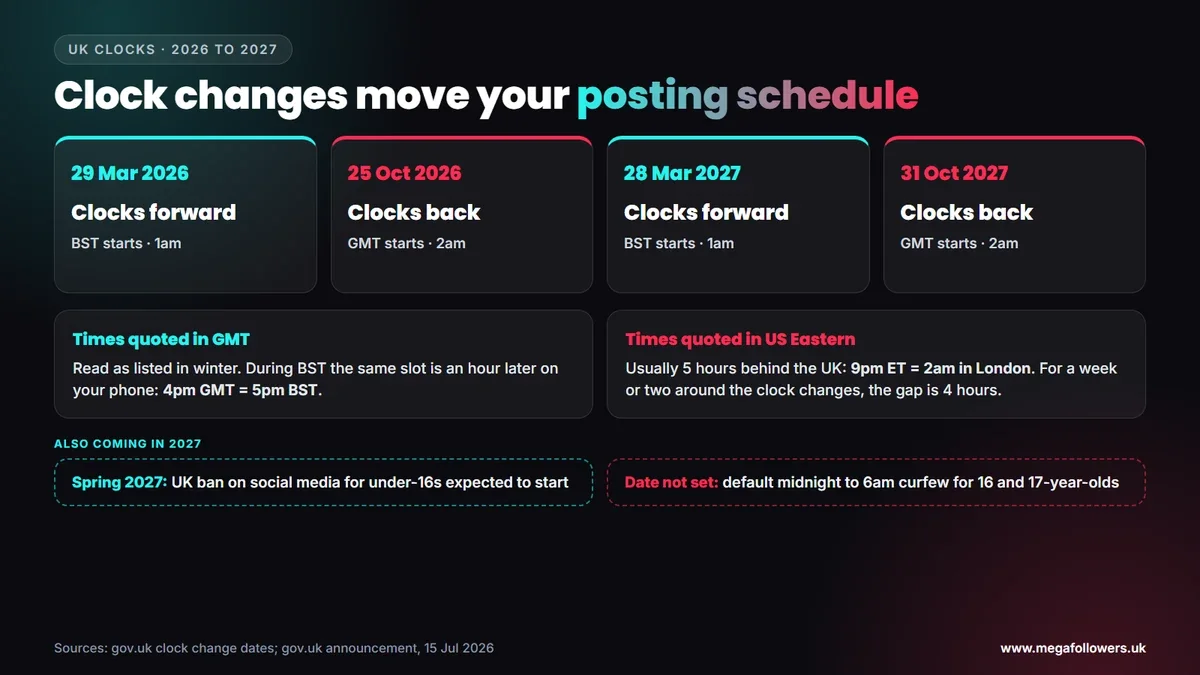
What most guides get wrong: they quote US Eastern Time, or one global average, as if it applied to London. Check the time zone behind any posting time before you use it.
Advice written for American audiences usually quotes Eastern Time, which runs five hours behind the UK for most of the year. A "9pm ET" tip? That's 2am in London. For a week or two around each clock change the gap shrinks to four hours, because the US moves its clocks on different dates.
Splitting your audience between the UK and the US? Buffer's advice is an early-afternoon post on New York time, which reaches British viewers around teatime. One post, two countries.
Your followers won't change their habits when the clocks change, but your schedule will. If you use a scheduling tool, check the time zone it shows after 25 October, and again after 28 March, so your 9pm post doesn't quietly turn into 8pm or 10pm.
Does posting time matter on TikTok?
Yes, though it decides when a video meets its first viewers rather than how far it travels. TikTok's Creator Academy says videos go further on the For You feed based on the recommendation system's performance predictions and user engagement. Its advice for more traffic is simple: post more often.
Timing matters most for accounts with an established following. Post while your followers are online and the video gets its first views sooner. Post at 4am and it waits.
After that, the way viewers engage with it shapes how far TikTok recommends it. Even Buffer, whose business is scheduling, calls timing one of many factors and no magic bullet.
Content still carries the most weight. TikTok's analytics track retention rate, the share of a video people watch, and its own guide tells creators to find the drop-off points and work out why viewers lost interest. Fix those and every slot works harder.
New viewers also size a video up quickly. A clip that already shows healthy numbers looks worth watching, which is why some creators add TikTok views as social proof to a post they've timed well.
What changes for UK TikTok posting times in 2027
Four dated changes will shape UK posting times through 2027. Two come from government, one from the calendar, and one from the studies themselves.
- Clock changes: UK clocks go forward on 28 March 2027 and back on 31 October 2027 (gov.uk). Re-check your schedule on both dates.
- Under-16s: the government said on 15 July 2026 that its ban on social media services for under-16s is expected to come into force in spring 2027. If your audience includes younger teens, expect your after-school figures to change.
- 16 and 17-year-olds: the same announcement set out default overnight curfews from midnight to 6am on social media apps. No start date has been confirmed. If your audience skews 16 to 17, a midnight post may wait until morning to reach them.
- New studies (our view): Buffer updated its TikTok study in September 2026 and Sprout in March 2026, so expect fresh figures during 2027. Re-check this table when they land.
Our view on the rest: the method in this guide won't date. Keep testing your own slots every quarter, and let your Follower activity chart overrule any study, including the ones above.
Pick your slot, then give new viewers a reason to stay
The right time gets your video in front of people. What happens next depends on what they see when they land: the hook, the caption, and numbers that show other people have already watched.
Mega Followers UK helps with that last part. TikTok likes and TikTok followers from real-looking accounts give a new video or profile instant social proof. There's no password required, and every order comes with a 30-day refill guarantee.
For the content side, read how the TikTok algorithm works, why your TikTok views might be low and how to get more likes on TikTok. Posting on Instagram too? Here's the best time to post on Instagram, and our FAQs cover orders and refills.
FAQ: TikTok posting times in the UK
Which day gets the most TikTok engagement in the UK?
Thursday is the strongest day for UK TikTok engagement, according to Sprout Social's analysis of 25 million UK TikTok engagements, with activity running from 4pm to midnight. Saturday was the weakest UK day. Buffer's global data disagrees and ranks Saturday first, so test both days with your own audience.
What time is TikTok busiest in the UK?
UK engagement on TikTok peaks in the late afternoon and evening. Sprout Social's UK data shows the strongest windows between 3pm and midnight from Monday to Thursday, with Friday and Sunday narrowing to 10pm to 11pm. Your own Follower activity chart in TikTok Studio shows the busiest hours for your followers.
Is it better to post on TikTok in the morning or at night?
Night wins for a UK audience. Sprout Social's UK data places almost every strong window after 3pm, stretching to midnight on Mondays and Thursdays. Morning slots do well in Buffer's global data, especially Sunday at 9am, so a weekend morning post is worth testing once.
How many times a day should I post on TikTok?
There's no official number. TikTok's Creator Academy says posting more often gives the recommendation system more chances to understand your content and find the right audience. Start with a schedule you can keep up, such as one post a day in your best slot, then add a second slot once you've tested it.
Can you schedule TikTok posts for the best time?
Yes. You can schedule posts from TikTok's desktop upload page and from TikTok Studio, which means a 10pm slot doesn't need you sitting on your phone at 10pm. Check the time zone the scheduler shows before you confirm, especially around the UK clock changes on 25 October 2026 and 28 March 2027.
What is the worst time to post on TikTok?
For a UK audience, Saturday is the weakest day in Sprout Social's data, and weekday mornings fall outside every strong UK window. Buffer's global data shows afternoons between 12pm and 5pm with the lowest engagement on most days. Avoid the small hours unless your followers live in another time zone.