How to Do Affiliate Marketing on Instagram and TikTok: A UK Beginner's Guide
Learn how to do affiliate marketing on Instagram and TikTok in the UK: the 500-follower TikTok Shop rule, ASA ad labels, HMRC tax and 7 steps to start.
In this article
Quick answer: To do affiliate marketing on Instagram and TikTok, join a programme, get a tracked link or code, and post content that shows the product in use. TikTok Shop UK lets creators aged 18+ apply from 500 followers. On Instagram, links go in your bio and Stories. Label every post "Ad" at the start.
You want to earn from the products you already talk about. Yet most guides on how to do affiliate marketing on Instagram and TikTok come from the US, so they quote the wrong follower bar and skip UK ad law entirely.
Follow them and you might wait months for a threshold you've already passed, or post a label the ASA calls insufficient. Not ideal. This guide covers both apps, with every UK rule checked in September 2026.
What affiliate marketing on Instagram and TikTok means
Affiliate marketing pays you a cut of each sale that comes through your personal link or code. The brand tracks the purchase back to you and pays an agreed commission. You never hold stock, pack parcels or handle returns. Each programme sets its own rate, tracking window and payout schedule, so read the terms before your first post.
On TikTok, most beginners start with TikTok Shop. Creators browse products in its marketplace, attach them to their videos or LIVEs, and see the seller's commission rate before adding anything. The whole journey, from the first tap to the checkout, stays inside the app.
Instagram works differently. UK creators usually join a brand's own programme or sign up with an affiliate network, then share the tracked link in the places Instagram allows one. That means more set-up.
It also means more choice. You can promote almost any shop that runs a programme, including the small independent UK brands your followers already buy from and talk about in your comments.
Instagram vs TikTok for affiliates, side by side
TikTok gives beginners the faster route to a first sale, because the shop, the product link and the checkout all live in one place. Instagram rewards patience. It has fewer built-in tools, but you get more freedom over which brands you promote and where your audience lands.
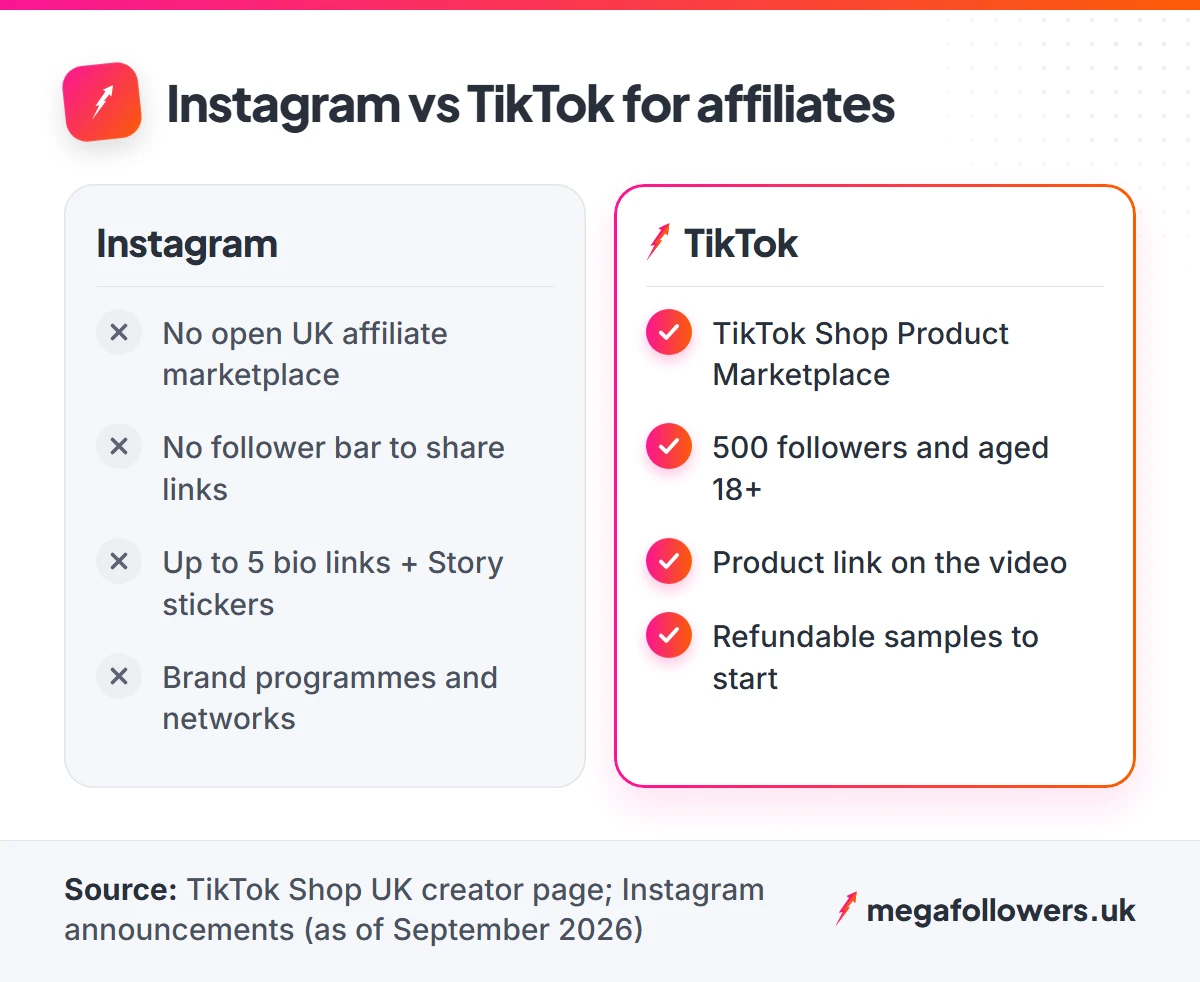
| Feature | TikTok | |
|---|---|---|
| Built-in affiliate marketplace | No open marketplace for UK creators; join brand programmes or networks | Yes, TikTok Shop's Product Marketplace |
| Follower bar to start | None to share a link; new accounts can't use the Link sticker | 500 followers for the TikTok Shop UK creator programme, plus 18+ |
| Where links go | Up to 5 bio links, Story Link stickers, DMs | Product links on videos and LIVEs, shop showcase |
| Samples | Negotiated brand by brand | Refundable samples at first, free sample requests later |
| Disclosure tool | Paid partnership label (for brand deals) plus "Ad" in text | "Disclose commercial content" toggle plus "Ad" in text |
| Best beginner format | Carousel reviews and Stories with a Link sticker | Short demo videos with the product attached |
One row needs a longer note than a table allows. Instagram opened the Link sticker to every account in October 2021, but brand-new accounts and repeat rule-breakers still can't use it. Build some posting history first. Features on both apps change often, so check each platform's own help pages before you plan a campaign around one.
The other big difference is buying intent. TikTok viewers are used to shopping while they scroll, whereas Instagram users more often save a post, think about it for a few days and come back to buy later. Expect a lag.
The 500-follower gate most guides get wrong
TikTok Shop's UK creator programme asks for 500 followers. Most of the guides ranking for this topic say 1,000, a figure that belongs to other markets.
What most guides get wrong: TikTok Shop's UK creator page lists four requirements as of September 2026. You must be at least 18, have a minimum of 500 followers, meet the Community Guidelines and pass an account risk evaluation. The 1,000-follower figure in many guides describes other markets.
Passing the gate doesn't give you everything at once. New creators join a Pilot Programme, where TikTok caps how many shoppable videos and LIVEs they can post each week, then lifts those limits as the following grows and the creator graduates. You also start with refundable samples, or you link products you already own using the search by image feature.
So the first job is simple. Reach 500 quickly and keep the account healthy. Content that earns follows does most of that work, and a starter base of TikTok followers from real-looking accounts can shorten the climb while you keep posting.
Stay in good standing the whole way. TikTok lists meeting the Community Guidelines as a condition, so a single strike can hold up your application even after you pass 500.
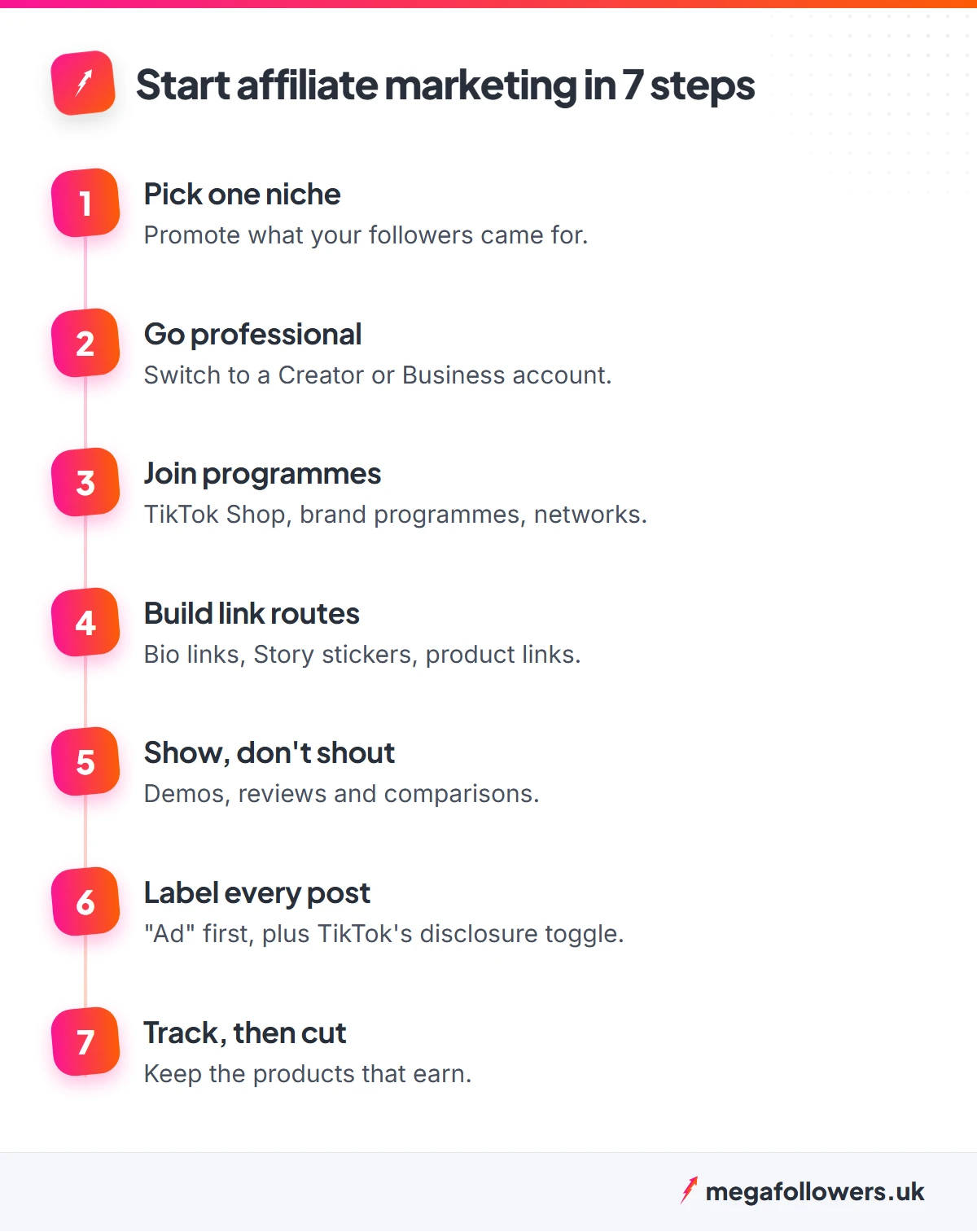
How to do affiliate marketing on Instagram and TikTok in 7 steps
These seven steps work on both apps, and where Instagram and TikTok handle something differently, the step spells out what to do on each. Start at the top.
1. Pick one niche you already post about
Promote products in the topic your followers came for. A skincare account suddenly pushing phone chargers confuses people, and it muddles the signals both apps use to decide who sees your posts. Stay narrow for three months.
2. Switch to a professional account
Professional accounts get analytics on both apps. You need those numbers to see which posts actually sell. On Instagram, open Settings, then Account type and tools, and switch to Creator or Business.
First impressions count here too. A profile with a credible base of Instagram followers makes a first-time visitor far more likely to trust your recommendation and tap through.
3. Join the right programmes
On TikTok, apply to TikTok Shop from the creator page once you meet the bar. For Instagram, check whether brands you already use run their own programme, then look at the big affiliate networks that list hundreds of UK retailers in one dashboard.
Read each programme's rules before you post. Some ban paid ads on the brand's name, while others forbid sharing your code on voucher and cashback sites because it steals sales from their own marketing.
4. Build your link routes
Instagram allows up to five links in your bio: tap Edit profile, then Links, then Add external link. Use a Story with a Link sticker for time-limited offers, and answer "where's that from?" comments with a DM containing the link.
TikTok keeps it tighter. You attach the product to the video itself, so a viewer taps the product link without ever leaving the app, which removes the point where most shoppers drop off.
5. Make content that sells without shouting
Show the product solving a real problem. Short demos, honest "after a month" reviews, side-by-side comparisons and "what I use every day" round-ups all tend to work well. Keep the pitch to one line.
Camera-shy? Hands-only demos and voiceovers work well for creators who'd rather stay off screen.
Reach matters just as much. Any demo that stalls at 200 plays won't sell, and early TikTok views give a strong video social proof from its first minute online.
6. Label every post
Start the caption with "Ad". TikTok also has a disclosure setting: tap Content disclosure and ads, turn on Disclose commercial content, then pick "Your brand" or "Branded content". TikTok's help page shows which label each option adds, and the next section covers the UK rules.
7. Track, then cut
Check your programme dashboards every week. If a product gets plenty of clicks but no sales after a full month, drop it and give that slot to something your audience already asks about. Keep the winners. Most networks show clicks, orders and earnings per link, so name each link after its placement (for example "ig-bio-serum" or "tt-demo-serum") and you'll see which post does the selling.
How to label affiliate posts under UK ad rules
Every post with an affiliate link or code counts as an ad in the UK. According to the ASA, a creator who earns commission is acting as an advertiser, so the label must appear upfront, before anyone clicks.
The ASA and CAP updated their guidance on recognising ads on social media on 6 August 2026. US-written guides tend to quote the American FTC instead. Its advice differs.
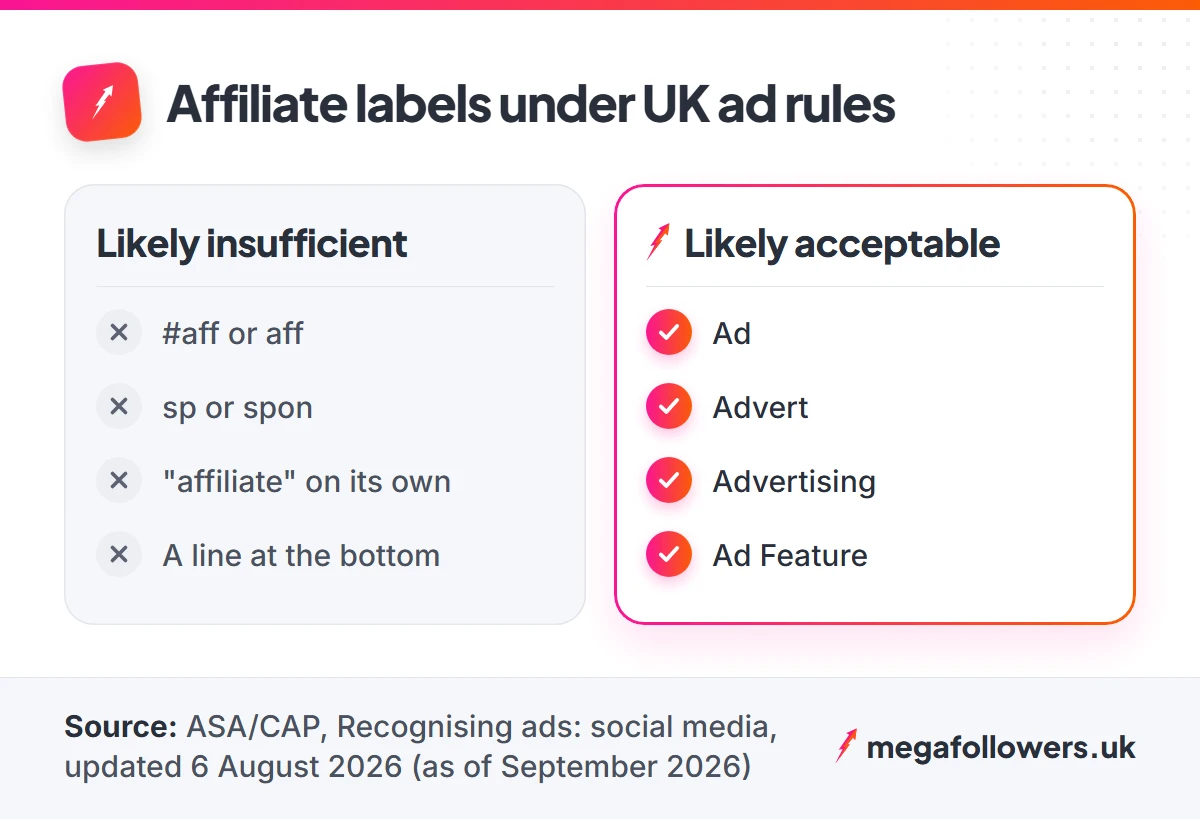
Labels that pass
ASA guidance counts these as likely acceptable. Use one at the very start of the post, before any hashtags, emojis or product talk:
- Ad
- Advert
- Advertising
- Ad Feature
Labels that fail
Avoid these. The ASA treats them as likely insufficient, because most shoppers never read them as meaning "advertising" at all:
- aff or #aff
- sp or spon
- affiliate, on its own
- a line at the bottom of the caption, such as "I may earn a commission"
Placement matters as much as the word. Put the label at the very start of the caption, or on screen in the first frame of a video, so nobody has to tap "more" to find it. Stories need the same care. Add "Ad" as text on the first frame of any Story that carries an affiliate link, because viewers can tap the Link sticker long before they reach a later frame.
Instagram built its Paid partnership label for brand deals, so for an affiliate post the "Ad" at the start of your caption does the job. Save the tool for paid brand deals.
Codes don't cover you either. A personal discount code on its own fails to show the commercial relationship, the ASA says. Brands share responsibility for affiliate posts, so a well-run programme will check yours and may ask you to fix them.
Do you pay tax on affiliate income in the UK?
Yes, once your side income passes £1,000 in a tax year. HMRC gives you a single £1,000 tax-free allowance across all your side hustles, and affiliate commission counts towards it.
Two details catch people out. HMRC's rules for content creators count free products you get for promoting a brand as income, at their value. And the allowance covers all side income together. Gifted items count at their value, so a £300 bundle you keep after a review adds £300 to your total.
Here's an example. Someone who earns £600 in commission and £500 from weekend dog-walking has gone over the limit, even though neither amount looks big on its own.
Cross the line and you register for Self Assessment as a sole trader. The deadline is 5 October after the tax year ends (the tax year runs from 6 April to 5 April). For the tax year ending 5 April 2027, that means registering by 5 October 2027.
- Log every payout and every gifted item in one spreadsheet.
- Download programme statements as PDFs each month.
- Speak to an accountant once affiliate income turns regular.
Beginner mistakes that stall affiliate income
Most stalled affiliate accounts share a handful of habits. Every one of them is easy to fix once you spot it.
- Promoting everything. Ten unrelated products in a month tells followers you'll sell anything. Pick three you'd buy again with your own money.
- Burying the link. "Link somewhere in my bio" loses people. Name the exact link, or pin the product.
- Hiding the label. A late or vague label risks an ASA ruling. It also costs trust when followers spot it.
- Posting and vanishing. Unanswered questions under a product video lose sales. Stay for the first hour and reply.
- Ignoring programme rules. Some brands ban voucher-site sharing or paid ads on their name, and they claw back commission if you break the terms.
- Copying US captions. Templates written for American rules often put the disclosure at the end, which fails the ASA's upfront test.
- Chasing the highest rate. For example, a 20% commission on something nobody wants earns less than 5% on a product your followers already ask about.
The rules mistake hurts most. Commission you thought you'd banked can vanish in a single compliance review, and some networks close the account too.
Links earn when the profile looks worth a tap
Your link only works if a stranger trusts your profile enough to tap it. That judgement takes seconds and rests on what they see first: your follower count, the likes on recent posts and how busy your comments look. Strong social proof gets more strangers to stop, look and listen to what you recommend.
Mega Followers UK helps new affiliate accounts look established while the content catches up, with Instagram likes and TikTok likes from real-looking accounts, a 30-day refill guarantee and no password required. Then get the timing right: read how the TikTok algorithm works and the best time to post on Instagram, and check our FAQs for anything about an order.
FAQ
Can you do affiliate marketing on Instagram with no followers?
Yes. Instagram sets no follower minimum for sharing affiliate links in your bio, and many brand programmes accept small accounts. Brand-new accounts can't use the Story Link sticker straight away, though. Build a posting history first, and expect sales to stay small until people trust your recommendations enough to buy.
How much commission do TikTok Shop affiliates earn?
It depends on the product. Each TikTok Shop seller sets a commission rate for their products, and you see that rate in the Product Marketplace before you add anything to your showcase. Compare the rate with the price and how well the item suits your audience, because a lower rate on a bestseller often pays more.
Do you need a website to be a social media affiliate?
No. TikTok Shop runs entirely inside the app, and most brand programmes accept social media accounts as the promotion channel. Some networks ask for a website URL during sign-up, but many now accept a profile link instead. Look for a social media option on the form first.
Can under-18s join TikTok Shop as affiliates?
Not in the UK. TikTok Shop's UK creator programme requires you to be at least 18 years old, alongside the 500-follower minimum and an account risk check. Younger creators can still build an audience and post about products they like, but they can't earn commission through TikTok Shop until they turn 18.
Is a discount code enough to show a post is an ad?
It isn't. The ASA says a personal discount code on its own is insufficient to show the commercial relationship between you and the brand. Add a clear label such as "Ad" at the start of the caption, even when the post also carries a code. On TikTok, switch on the disclosure setting too.
Should affiliate links go in captions on Instagram?
Avoid it, because Instagram doesn't make links in captions clickable. Put affiliate links in your bio, on a Story Link sticker or in a DM reply. Then tell viewers exactly where to look, for example "second link in my bio", so they don't give up before they find it.